
Trigonometry
The biggest topic on Paper Two: from right-angled triangles and the sine rule to radians, arcs, and sectors — the foundation of the whole spatial block.
Topic Importance
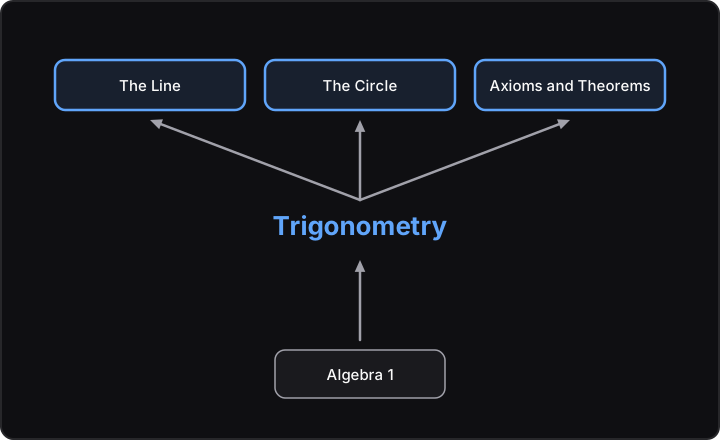
Trigonometry is the most important topic on Paper Two. It has appeared in 45 questions over the last 12 years — the biggest count on the paper — and it is important for a second reason: the whole spatial block runs on it. The line, the circle, and the axioms and theorems all reach for trigonometry when angles enter the picture.

As the Paper Two overview explained, trigonometry appears on both papers in different guises: Paper One uses it symbolically — doing maths on the sine and cosine functions — while Paper Two uses it spatially, working out angles from points, lines, and circles. This topic is the spatial side, and it is the foundation to lay before the rest of the spatial block.
What the Topic Covers
The topic starts in the right-angled triangle: its basics, including the hypotenuse rule, and then the trigonometric functions — sine, cosine, and tangent as ratios of the triangle's sides.
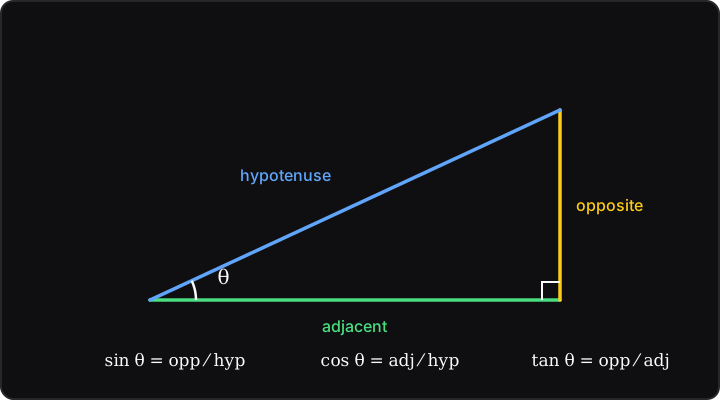
From there, how the angles relate: complementary angles (the two acute angles of a right-angled triangle add to 90°) and the co-function identities — different functions naming the same ratio of sides. Then the functions step outside the triangle: their period, frequency, and amplitude, read visually from graphs.
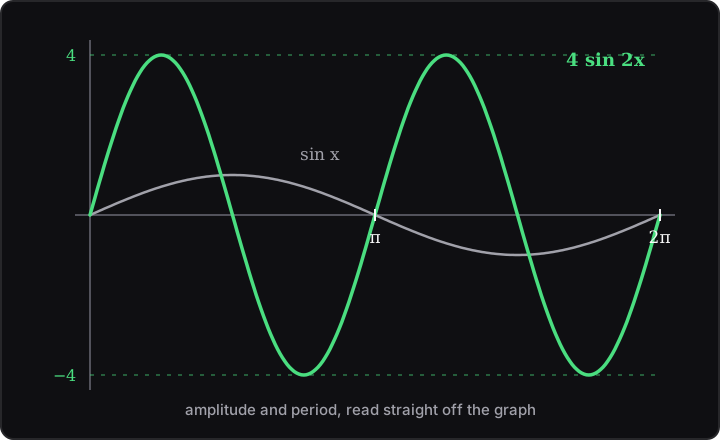
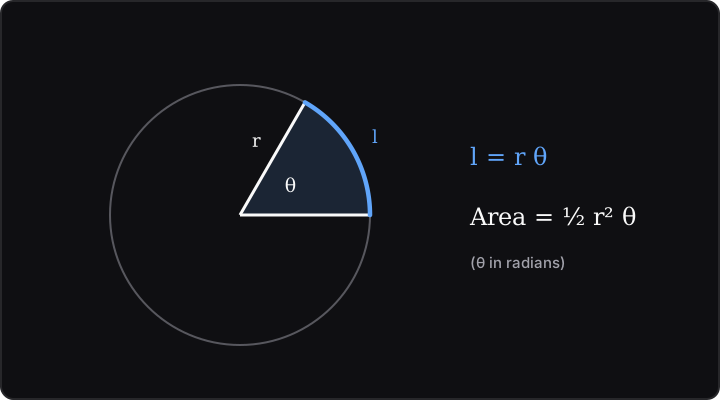
Back in the triangle, the tools generalise beyond right angles: the sine rule, and the area formulas — from half base times perpendicular height, to the trigonometric form, to Heron's formula. The topic closes by rethinking angles themselves: radians and degrees, and arc lengths and sectors in both.
In a right-angled triangle, the hypotenuse is 10 and one angle is \(30^\circ\). Find the length of the side opposite that angle.
A sector of a circle of radius \(6\,\text{cm}\) has an angle of \(\frac{\pi}{3}\) radians. Find the arc length and the area of the sector.
Exam Correlations
Trigonometry appears 45 times over 12 years, and its correlation table tells the two-papers story: the strongest partners are differentiation (6) and integration (3) from Paper One's symbolic side, and the circle (5) and the axioms and theorems (3) from Paper Two's spatial side.
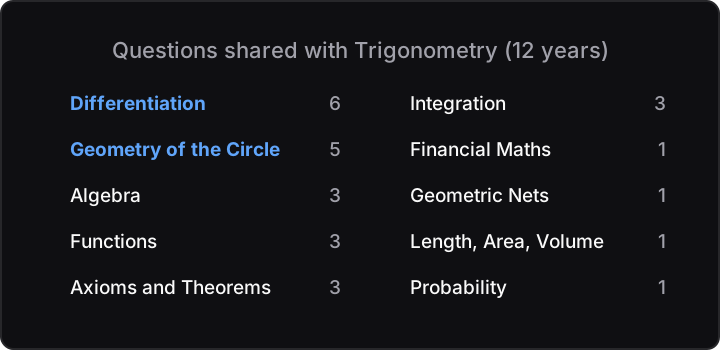
A note on the counts: "Algebra" bundles Algebra 1 and Algebra 2 together, and "Differentiation" bundles Differentiation 1, 2, and 3. The calculus numbers reflect Paper One questions that differentiate or integrate a trigonometric function; the circle and theorems numbers are the spatial partnership this paper is built on. The usual caveat about co-occurrence applies to the scattered single counts.
No other Paper Two topic pays out twice like this: trigonometry's own 45 questions are the biggest count on the paper, and the line, circle, and theorems questions lean on it too. Study it first in the spatial block.
Concept Connections
Trigonometry needs very little coming in — some basic algebra — and everything in the spatial block flows out of it.
Study Order
There are eight sub-topics in Trigonometry, and the arc is deliberate: start spatially in the right-angled triangle, build up the functions visually through graphs, then apply them to areas before finishing with the more abstract work on angles themselves. Click each step to see how they build.
Basics of the Right-Angled Triangle
The starting point, including the hypotenuse rule: the square on the hypotenuse equals the sum of the squares on the other two sides. Everything in the topic begins from this triangle.
The Trigonometric Functions
Sine, cosine, and tangent, introduced as what they are in space: ratios between the sides of the right-angled triangle, fixed by the angle.
Complementary Angles and Co-function Identities
How the angles inside the triangle relate: if one acute angle is \(30^\circ\), the other is \(60^\circ\) — and the co-function identities follow, because different functions of complementary angles name the same ratio of sides.
Period, Frequency, and Graphs
The functions outside the spatial context: their period and frequency, learned visually — given the graph of \(4\sin(2x)\), can you spot the amplitude and the period? And in reverse, can you sketch it?
The Sine Rule
Beyond the right angle: in any triangle, each side over the sine of its opposite angle gives the same value — the tool for solving triangles that have no right angle in them.
Area Formulas
Half base times perpendicular height is the classic — but how do you get the perpendicular height? Trigonometry answers it, giving the trigonometric area formula, with Heron’s formula on top for when only the sides are known.
Radians and Degrees
A step back to think about angles themselves: what radians and degrees each mean, how they relate, and how to move between them — needed immediately in the next step.
Arc Lengths and Sectors
The closing application, in both degrees and radians: the length of an arc and the area of a sector, where the radian measure makes the formulas almost effortless.
Know your gaps before the exam does
The MathsHelp course is everything you need for Leaving Cert Higher Level Maths, in one place. Smart testing pinpoints exactly where you are losing marks, explainer articles teach you the curriculum, an AI tutor works through your specific weaknesses, and real past papers — organised by topic, with guides — prove you are exam-ready.
- 15 articles on this topic
- 156 questions on this topic
- 1,300+ custom questions
- 280 explainer articles
- 12 years of past papers by topic