Building a Smart Study Plan for Paper Two
The Leaving Certificate Higher Level Maths exam has two papers, and each paper covers a different set of topics. This guide looks at Paper Two.
This is the first article in the Paper Two series. Here we break down the paper overall. Breakdowns of specific topics, such as Trigonometry, will follow in the next articles.
Paper Two is more straightforward than Paper One. The questions are more consistent, and the topics are less tangled together. But they are still somewhat connected — and those connections shape the study order. As with Paper One, the goal is the most marks for the least study time, and we will look at three things:
Marks
Which topics carry the most marks.
Hidden links
Which topics quietly help the others.
Study order
The best order to study them in.
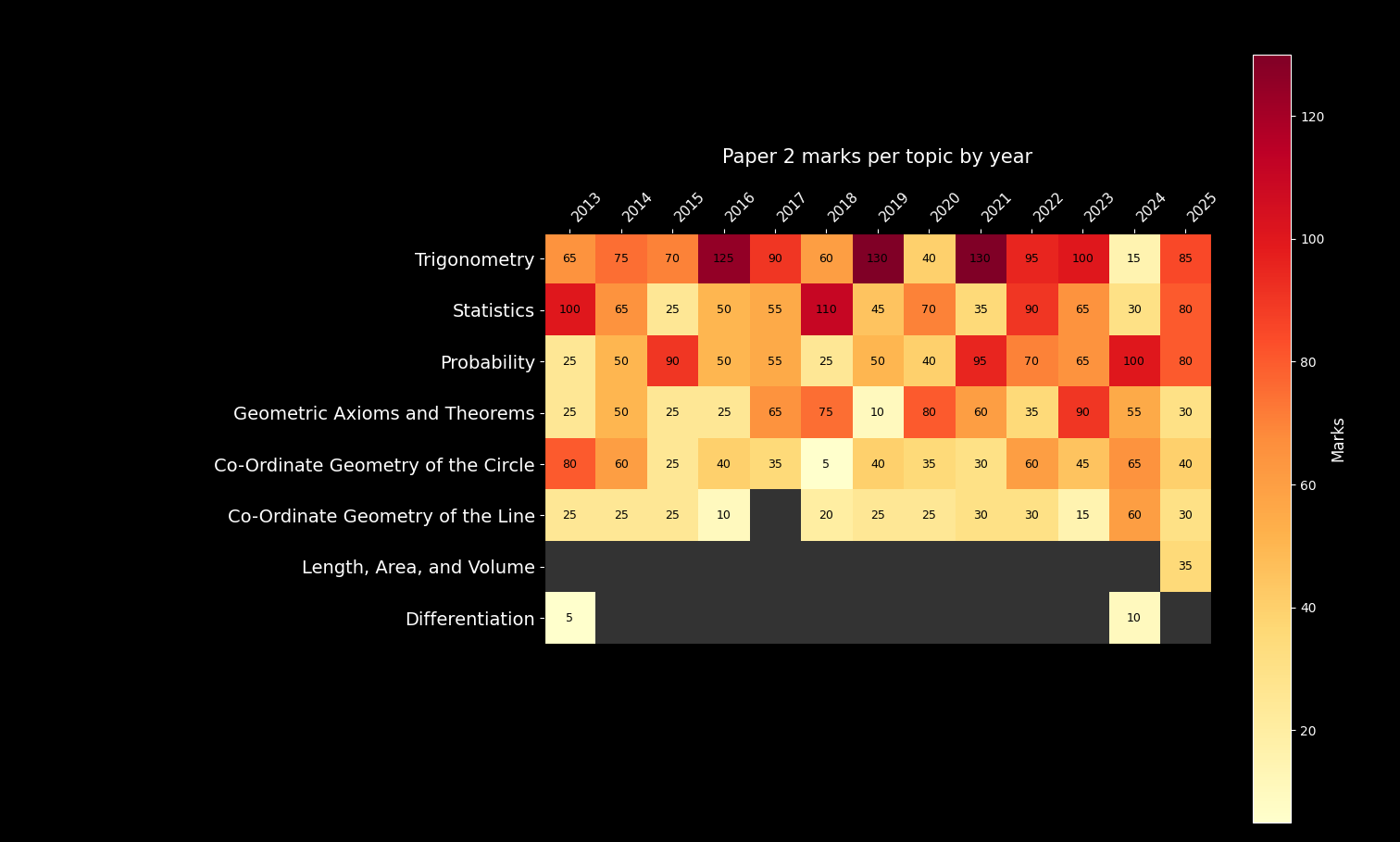
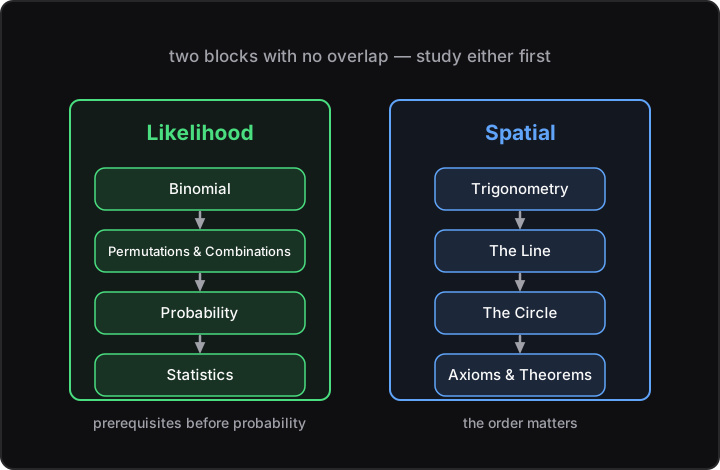
The shape of this paper is simple: it splits into two blocks. The most important topic is trigonometry. It is not just worth a lot of marks on its own — it also feeds into a wider set of topics: the line, the circle, and the axioms and theorems. Together those make up the spatial block of Paper Two. The other block is the likelihood block: probability and statistics, with binomials and permutations and combinations as the stepping stones into probability. Probability and statistics are also somewhat connected — not much overlap in their ideas, but in the exam they can be bundled into the same question.
Probability
Trigonometry is the most important part of this paper for marks. But we will start on the likelihood side, with its centrepiece: probability.
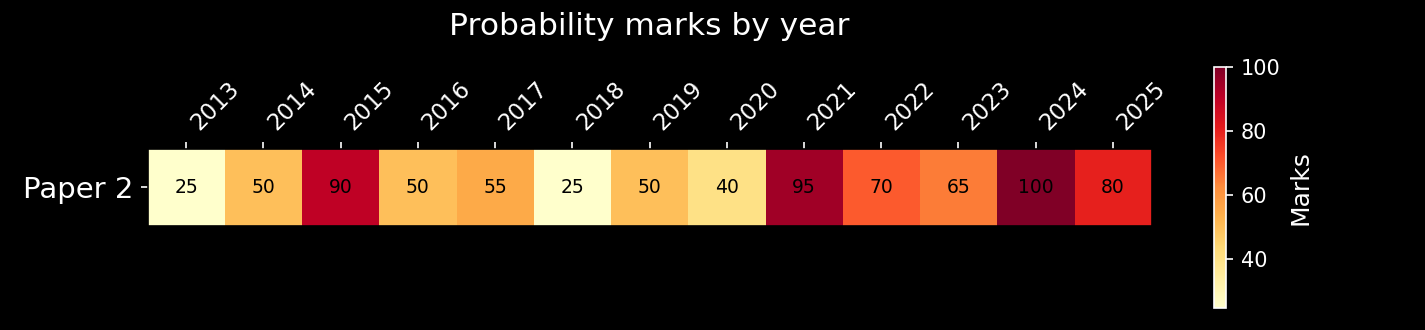
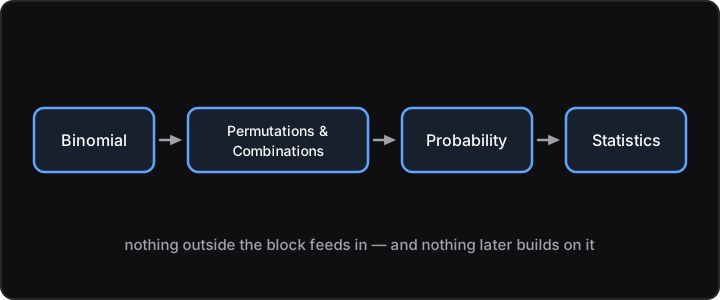
One thing to know about this marks data: the past paper questions are categorised as probability, but that label has two topics hiding inside it. Binomials and permutations and combinations do not generally come up on their own — they usually appear in the context of a probability question. So when you study for the probability marks, you are really studying a chain of three topics.
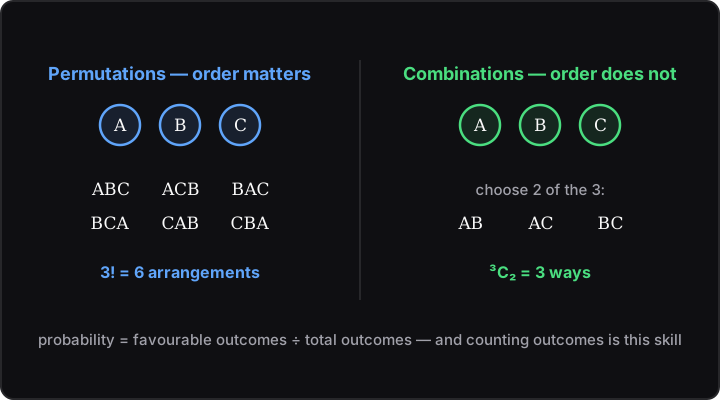
Permutations and combinations are the maths of counting. A permutation counts the ways things can be arranged, where order matters; a combination counts the ways things can be chosen, where it does not. Probability leans on this constantly, because a probability is favourable outcomes divided by total outcomes — and counting those outcomes is exactly this skill.
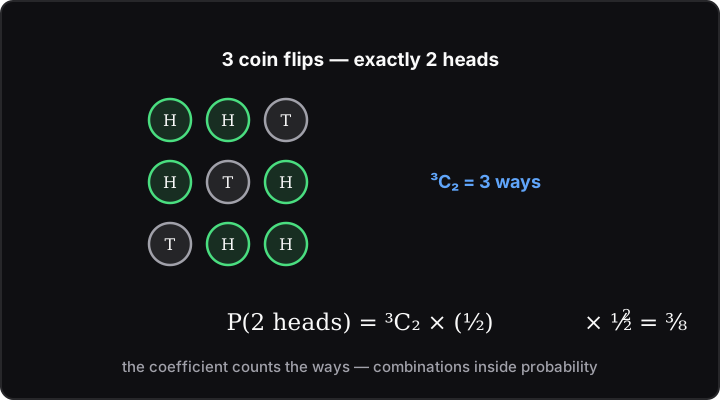
The binomial topic gives you the "n choose k" numbers — the binomial coefficients from expanding brackets like (x + y)n. In Leaving Cert probability they power the classic repeated-trials question: the chance of exactly so many successes in so many attempts. The coefficient counts the ways those successes can be arranged among the attempts — combinations again, working inside probability.
That is why the study order inside this block runs binomials first, then permutations and combinations, and then probability itself.
Statistics
After probability comes statistics.
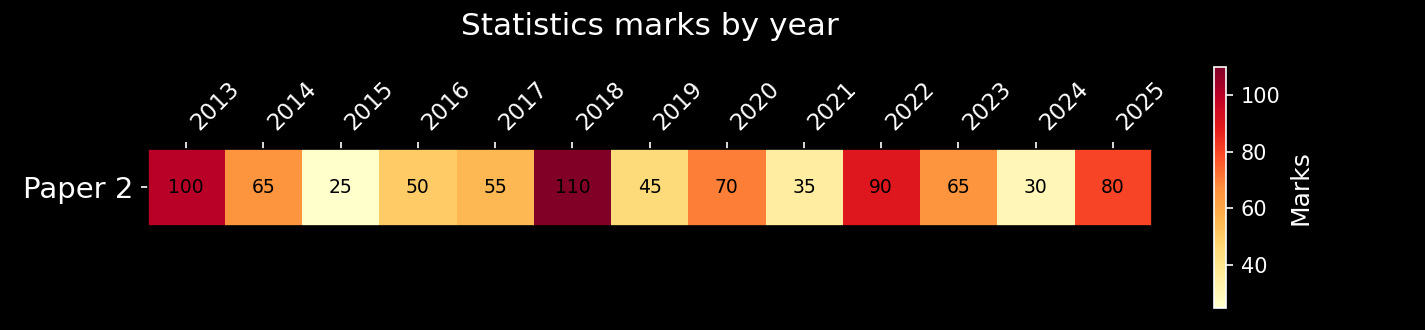
Probability and statistics do not really overlap in their ideas. You will probably not need to know much about one to answer the other. But here is the catch from the past papers: one question can have two parts, where one part is a statistics question and the other is a probability question — sometimes even using the same data given at the start.
Beyond the probability chain, the likelihood block needs very little: some algebra to get going, and after that you mostly just crunch numbers and learn the concepts. And it does not lead anywhere else — no later topic builds on it. It is a fairly self-contained unit.
Trigonometry
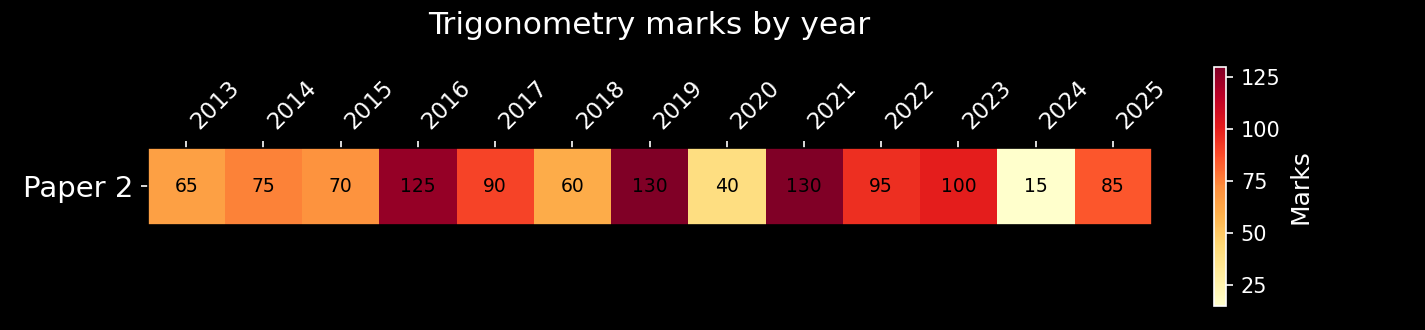
Now the most important topic. Trigonometry matters for two reasons. First, it is worth a huge amount of marks on its own. Second, it feeds into the other spatial topics: the line, the circle, and the axioms and theorems. Questions from those topics will not always use trigonometry — but they often will. You will often have to work with the angles made by two lines crossing, or the angles inside a circle, and that needs some trigonometry.
You may notice that trigonometry is also on Paper One. Roughly speaking, the two papers use it in different ways. Paper One is more symbolic trigonometry: working with sine and cosine functions and doing maths on them. Paper Two is more spatial: working out angles from points and lines, and working with them that way.
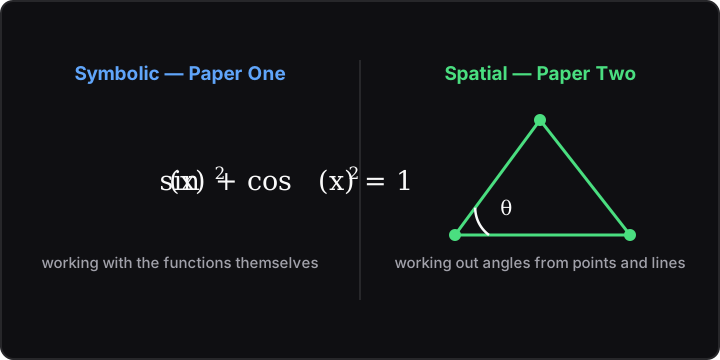
There are not many prerequisites, but the symbolic trigonometry from Paper One is worth learning first — then you can apply it to the spatial questions here. One thing to note: on Paper One, trigonometry also leaks into other topics in small ways. In differentiation, for example, you may have to differentiate a trigonometric function, get another trigonometric function back, and work with the result. But on the whole, trigonometry is fairly self-contained on Paper One. It is here on Paper Two that it spreads out and matters for other topics.
The Line
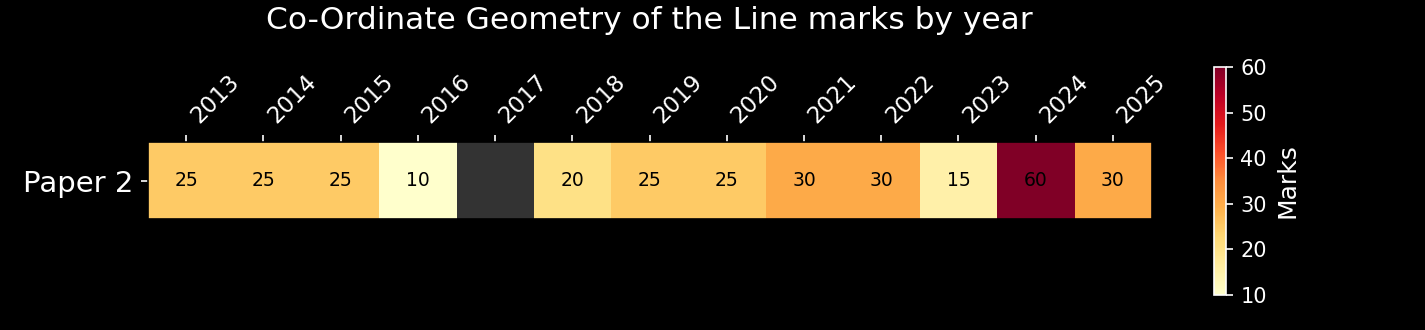
Next is co-ordinate geometry of the line. The line has a lot of value on its own, but it is also hugely important as a prerequisite for the circle questions.
Students usually find it easier than the circle questions, so it is a good place for everyone to pick up some marks without a ton of study. You will be dealing with things like where lines cross, or the distance between lines or points — and you will need to rely on some trigonometry.
The Circle
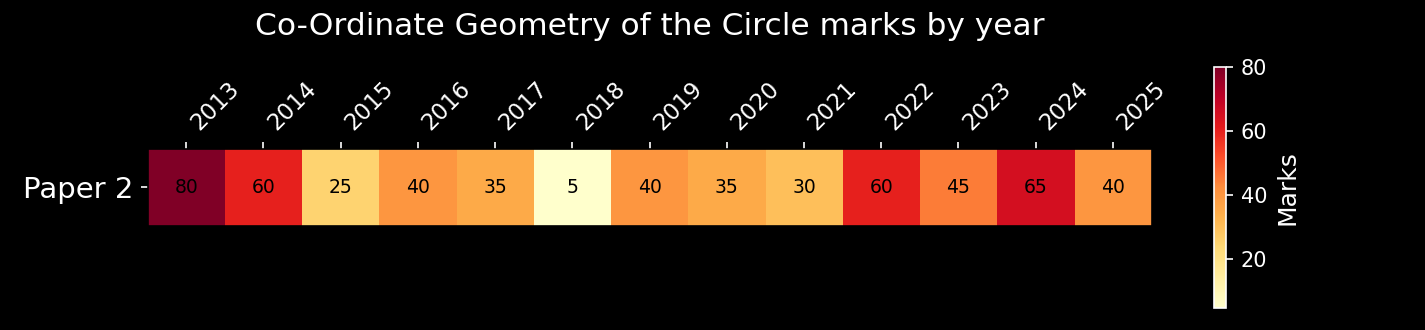
Next is the circle — its full name is co-ordinate geometry of the circle. Like all the topics on Paper Two, it comes up every year. It is worth a good amount of marks, and the questions are usually quite similar from year to year.
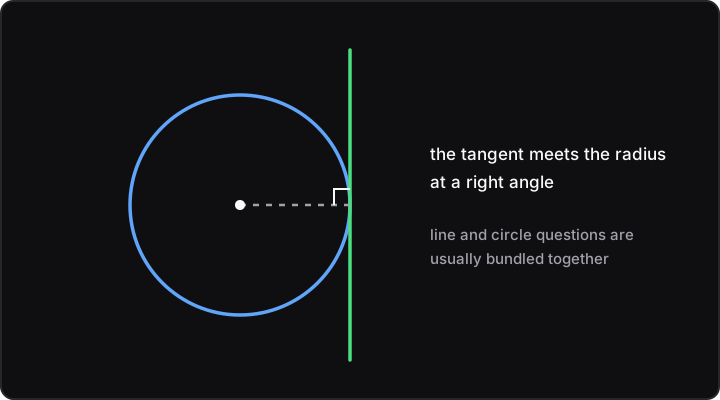
One thing to note: this topic is closely tied to the line. They are linked in two ways. First, the concepts relate to each other. Second, questions from both topics are often bundled together.
Geometric Axioms and Theorems
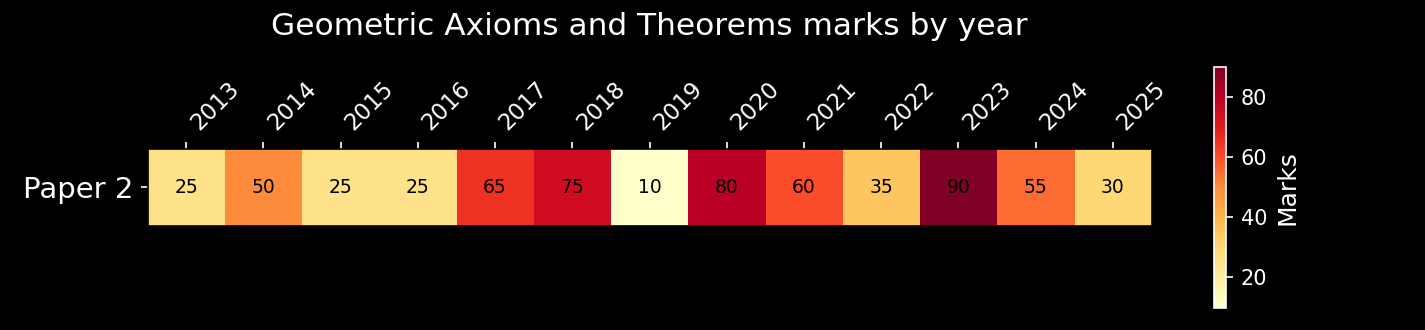
Last of the spatial topics is the axioms and theorems — as you can see, they have come up in every past paper so far. In general, you will need them to answer questions about lines and circles.
You will not usually be asked to state a theorem or an axiom, or to prove one. Instead, they are tools. You use them to solve bigger problems with lines and circles.
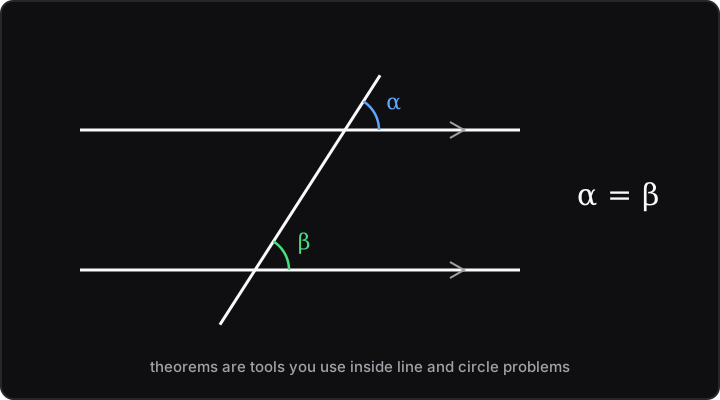
They do need some study, but you will find a lot of them intuitive. You just need to see what tools are available — after that, you will probably pick them up quite quickly, and sharpen the skill by using them in past papers. So you probably should not spend a lot of time trying to memorise the theorems.
A Note on Paper One Topics
You will see a couple of topics in the marks data that you may recognise from Paper One. Do not be misled by them.
The first is length, area and volume. It may be somewhat useful, since we deal with shapes a lot on this paper — but you will not have to rely on serious Paper One knowledge here.
The same goes for differentiation. It is marked as coming up on Paper Two, but do not read too much into that. You will not have to answer any questions about derivatives or integration. A few times over the last decade or so, a basic idea like something changing has come up, worth a couple of marks — and the closest topic on the curriculum to that is differentiation. There is no serious calculus involved. Paper Two concepts crept into Paper One the same way, and the same rule applied there: it does not require any real study of the other paper's topics.
Building Your Study Plan
So that is what matters on Paper Two and how the topics connect. Now let us put it together as a study plan.
There are two blocks, and they have no overlap — so you can study either one first.
The first is the likelihood block, and it builds up to probability. Start with binomials, then permutations and combinations — they are the prerequisites for probability. Then study probability itself, and finish with statistics.
The second is the spatial block, and this one does have an important order. Trigonometry is your foundation — learn it first. Once you have mastered it, you can move on to the line. From there you are ready to study the circle. And finally, study the axioms and theorems: they are sprinkled throughout the questions on the other topics.
- Two blocks, no overlap — start with either.
- Likelihood: binomials, then permutations and combinations, unlock probability — with statistics to finish.
- Spatial: trigonometry is the foundation — learn it first.
- Then the line, then the circle, and the axioms and theorems to finish.
Know your gaps before the exam does
The MathsHelp course is everything you need for Leaving Cert Higher Level Maths, in one place. Smart testing pinpoints exactly where you are losing marks, explainer articles teach you the curriculum, an AI tutor works through your specific weaknesses, and real past papers — organised by topic, with guides — prove you are exam-ready.
- 1,300+ custom questions
- 280 explainer articles
- 12 years of past papers by topic
What Comes Next
You now know which topics are worth the most marks on Paper Two, and which topics to study first so that you can unlock the ones that depend on them. That is everything you need to build a high-level study plan.
From here, the series breaks the Paper Two topics down one by one. For each topic, we will cover what matters, which concepts are worth more marks, and how those concepts relate to one another — so you can build a fine-grained study plan that gets you the most marks for the least study time.
← Back to the Study Plan Guide Overview