
Geometric Nets
Folding flat: the 2D nets of 3D shapes — the smallest topic on Paper Two, and the fastest win on it.
Topic Importance
Geometric Nets is the smallest topic on Paper Two. It has appeared explicitly in just 1 question over the last 12 years — and it is also the fastest topic on either paper to cover.

That combination is the whole argument for studying it: the cost is an afternoon, the marks are occasionally there, and the spatial habit it trains — seeing how flat shapes and solids relate — loosely supports the geometry work elsewhere on the paper. Not strongly, but the ideas transfer.
What the Topic Covers
The topic is one idea: a net is a 2D shape that folds into a 3D shape. Unfold a solid along its edges and lay it flat, and the flat pattern you get is the net of that solid; fold the net back up, and the solid returns.
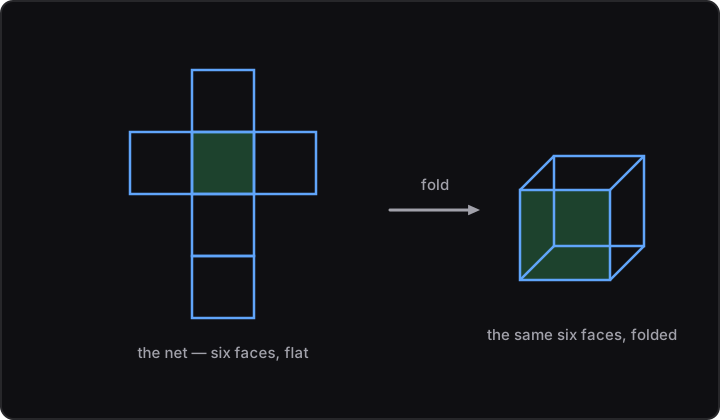
From there it is recognition practice: knowing the nets of the standard solids — the cube (which has eleven distinct nets), cuboids, cylinders, prisms, and pyramids — and working in both directions: naming the solid a given net folds into, and drawing a net for a given solid.
A net consists of a rectangle and two circles. What 3D shape does it fold into?
Draw a net for a cuboid measuring \(4\,\text{cm} \times 3\,\text{cm} \times 2\,\text{cm}\), labelling the dimensions of each face.
Exam Correlations
The correlations table for geometric nets is the shortest possible: one appearance in 12 years, shared with trigonometry.

Be honest with yourself about what this means: it is rare to be explicitly asked "what is the 3D shape of this net?". The value of the topic is mostly indirect — the same spatial visualisation turns up, in a weaker form, inside other geometry questions, where seeing how faces, edges, and angles fit together is half the work. Some ideas transfer; none of them are load-bearing.
Geometric nets is insurance, priced in minutes: the least study time of any topic on the paper, for marks that occasionally appear — and a spatial warm-up for the geometry block either way.
Concept Connections
Geometric nets is a standalone corner of the paper. The only thing worth having first is a passing familiarity with the standard solids — the cubes, cylinders, and prisms of Length, Area, and Volume on Paper One.
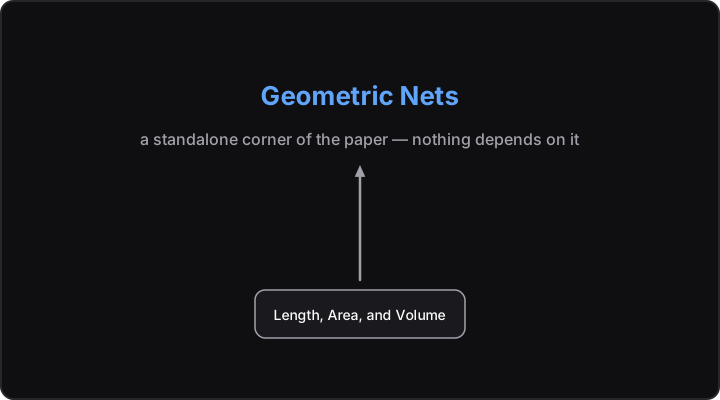
And outward? Nothing depends on geometric nets. The spatial visualisation it trains loosely helps the rest of the geometry block, but no topic requires it — study it whenever a light session suits.
Study Order
There are three short steps to this topic — it is the lightest study plan in the series. Click each step to see how they build.
What a Net Is
The single idea: unfold a solid along its edges and lay it flat — that flat pattern is the solid's net, and folding it back up recovers the solid. Everything else in the topic is this idea practised on different shapes.
Nets of the Standard Solids
Recognition practice on the solids you already know: the cube — which has eleven distinct nets — the cuboid, the cylinder, prisms, and pyramids. The skill is matching faces: a cylinder's net must be a rectangle with a circle for each end.
From Net to Solid and Back
The exam skill, in both directions: name the solid a net folds into, and draw a net for a given solid. The check is always the same — count the faces, match their shapes, and visualise which edges meet when it folds.
Know your gaps before the exam does
The MathsHelp course is everything you need for Leaving Cert Higher Level Maths, in one place. Smart testing pinpoints exactly where you are losing marks, explainer articles teach you the curriculum, an AI tutor works through your specific weaknesses, and real past papers — organised by topic, with guides — prove you are exam-ready.
- 1 article on this topic
- 25 questions on this topic
- 1,300+ custom questions
- 280 explainer articles
- 12 years of past papers by topic