
Geometric Axioms and Theorems
The toolbox of geometry: from the axioms of points and lines to the circle theorems — tools you use inside every spatial question.
Topic Importance
Geometric Axioms and Theorems closes the spatial block — and the whole Paper Two series. It has appeared in 22 questions over the last 12 years: in every single past paper so far.

As the Paper Two overview put it: you will not usually be asked to state a theorem or prove one. They are tools — you use them to solve bigger problems with lines and circles. That is why this topic comes last in the spatial order: the theorems are sprinkled throughout the questions on the topics you have already studied.
What the Topic Covers
The topic builds geometry from the ground up. It starts with the axioms about points and lines — such as the distance property — and then angle axioms: constructing an angle off a fixed ray by adding another line.
Angles then organise into structures: angles in triangles and the congruence axioms, followed by the more abstract angle relationships — vertically opposite, alternate, corresponding, and exterior angles.
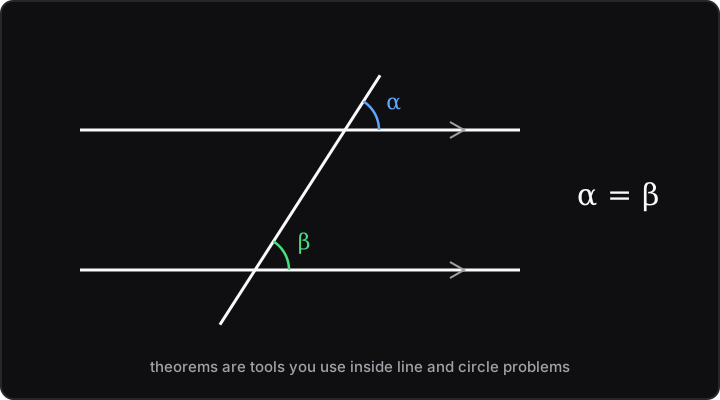
From triangles the shapes grow: quadrilaterals, with the parallelogram’s diagonal-bisecting property and the cyclic quadrilateral’s opposite angles, and finally the circle theorems and axioms — headlined by the inscribed angle theorem.
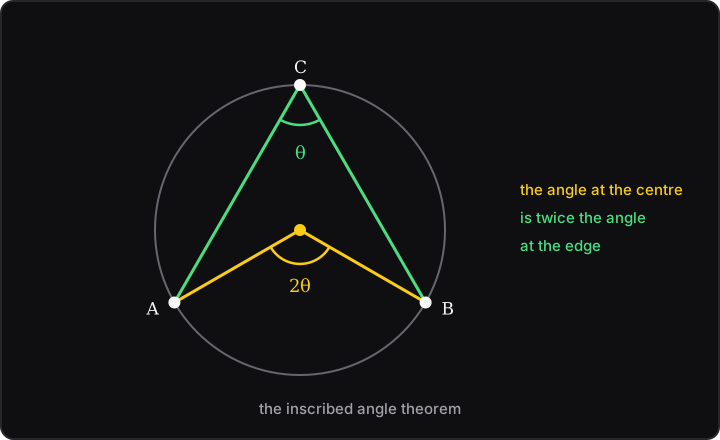
In a circle with centre \(O\), points \(A\) and \(B\) lie on the circle and \(\angle AOB = 100^\circ\). Find \(\angle ACB\), where \(C\) is a point on the major arc.
\(PQRS\) is a cyclic quadrilateral with \(\angle P = 70^\circ\). Find \(\angle R\).
Exam Correlations
Axioms and theorems appears 22 times over 12 years, and its partners are its own block: trigonometry with 3 shared questions, the circle with 2, the line with 1.
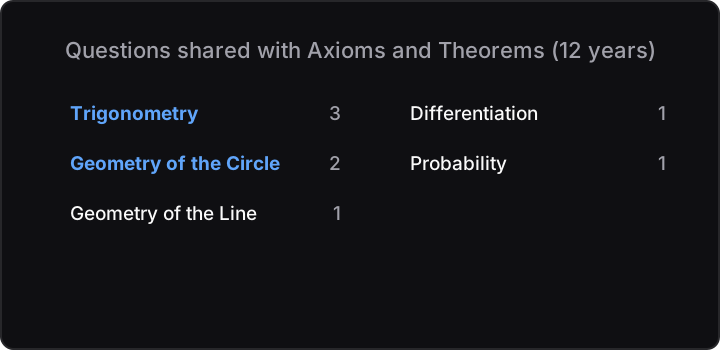
A note on the counts: "Differentiation" bundles Differentiation 1, 2, and 3. The numbers here understate the topic’s reach in the same way the binomial’s did on the likelihood side — because theorems are tools used inside line, circle, and trigonometry questions, their work is usually credited to those topics’ labels. The table shows where the explicit overlaps landed; the real usage is broader.
You should probably not spend a lot of time memorising the theorems. Most are intuitive once seen — learn what tools are available, then sharpen them on past papers, where they earn marks inside the other spatial questions every single year.
Concept Connections
Axioms and theorems is the capstone: all three of the other spatial topics feed into it, and nothing new comes after.
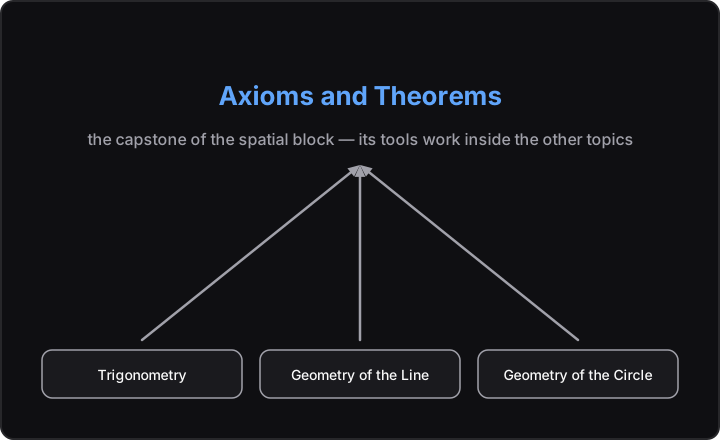
And outward? No new topic follows — this completes the geometry of the Leaving Cert series. But the theorems keep working: every future line, circle, or trigonometry question you practise is a chance to use them.
Study Order
There are six sub-topics in Axioms and Theorems, building from points and lines up to circles. Click each step to see how they build.
Axioms About Points and Lines
The ground floor: the axioms governing points and lines, such as the distance property. These are the facts everything else in geometry is allowed to assume.
Angle Axioms
Building on the line axioms: constructing angles from a fixed ray — given a line, adding another line to create an angle of a chosen size — and the rules that govern how angles combine.
Angles and Triangles
Angles organised into the first shape: the triangle, with its angle sum and the congruence axioms — the tests that tell you two triangles are the same triangle in different positions.
Angle Relationships
The more abstract relationships that power angle-chasing: vertically opposite angles, alternate and corresponding angles on parallel lines, and exterior angles of a triangle.
Quadrilaterals
Four-sided figures and their theorems: the parallelogram, whose diagonals bisect each other, and the cyclic quadrilateral, whose opposite angles sum to \(180^\circ\).
Circle Theorems and Axioms
The finale, on the shape from the previous topic: the circle theorems, headlined by the inscribed angle theorem — take two points on a circle, and the angle they make at the centre is twice the angle they make at any point on the edge.
Know your gaps before the exam does
The MathsHelp course is everything you need for Leaving Cert Higher Level Maths, in one place. Smart testing pinpoints exactly where you are losing marks, explainer articles teach you the curriculum, an AI tutor works through your specific weaknesses, and real past papers — organised by topic, with guides — prove you are exam-ready.
- 40 articles on this topic
- 198 questions on this topic
- 1,300+ custom questions
- 280 explainer articles
- 12 years of past papers by topic