
Co-Ordinate Geometry of the Line
Slopes, equations, distances, and angles: the co-ordinate toolkit for lines — easier marks than the circle, and the doorway to it.
Topic Importance
Co-ordinate geometry of the line is the second stop in the spatial block. It has appeared in 14 questions over the last 12 years, and it carries a double value: the questions themselves — which students usually find easier than the circle questions — and its role as the direct prerequisite for the circle.

As the Paper Two overview put it: the line is a good place for everyone to pick up marks without a ton of study. You will deal with where lines cross, distances between points and lines, and the angles lines make — leaning on the trigonometry you studied first.
What the Topic Covers
The topic starts with the line itself: what a line is, and its defining number — the slope, what it means and how to find it from two points.
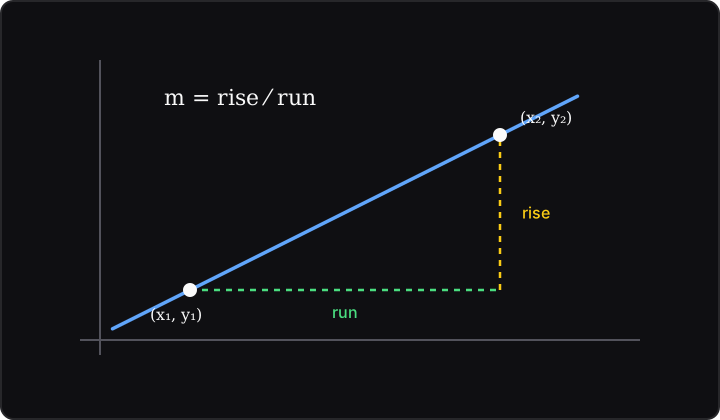
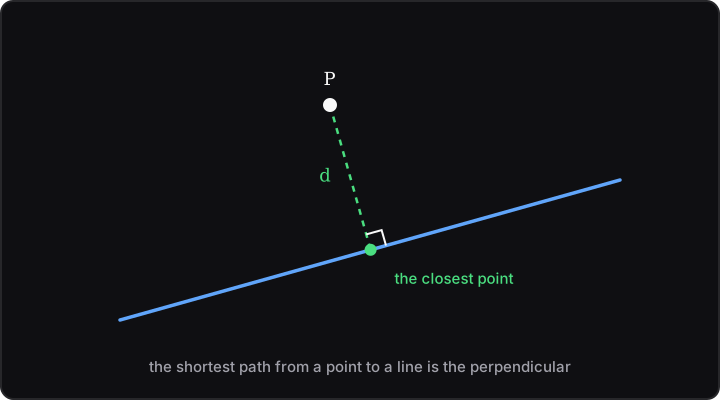
On that footing come the equations of the line in their different forms, testing points against them, and the two-point toolkit: distances and midpoints. Then lines start interacting — parallel and perpendicular lines (with horizontal and vertical as the special slope cases), where lines meet, the distance from a point to a line, and the angle relationships: the angle a line makes with the x-axis, and the angles between lines.
The topic closes with constructions built from all of it: collinearity and ratio points, intercepts and the triangle a line cuts from the axes, and the triangle centres — centroid, circumcentre, and orthocentre.
Find the equation of the line through \((1, 2)\) and \((5, 10)\).
Find the distance from the point \((3, 4)\) to the line \(3x + 4y - 10 = 0\).
Exam Correlations
Geometry of the line appears 14 times over 12 years, and its correlation table is short: the circle with 4 shared questions, and single co-occurrences with the theorems and probability.
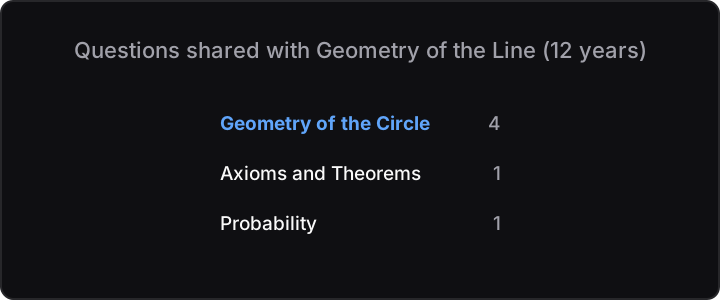
The circle number is the story, and it is the partnership the Paper Two overview described: the two topics are linked twice over — their concepts relate to each other, and their questions are often bundled together into one question with parts from each. The usual caveat about co-occurrence applies to the single counts.
The line pays twice: its own questions are among the most approachable on Paper Two, and every hour spent here is an hour of preparation for the circle questions bundled beside them.
Concept Connections
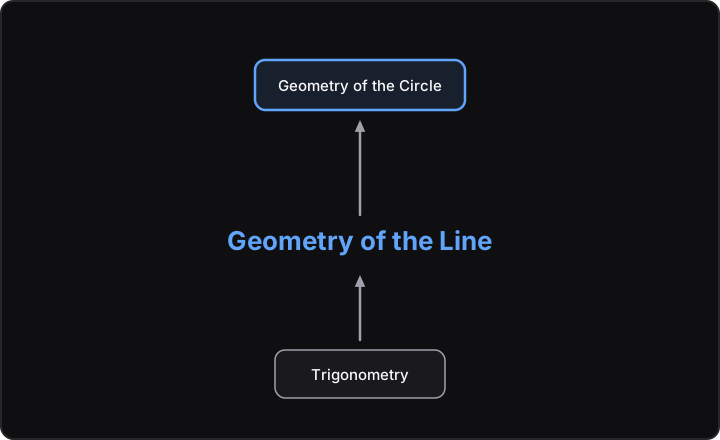
The line sits in the middle of the spatial chain: trigonometry feeds in, and the circle follows.
Study Order
There are eleven sub-topics in Geometry of the Line, in three blocks: the line itself, lines interacting, and the constructions built on top. Click each step to see how they build.
The line itself — points, slopes, and equations
Introduction to the Line
What a line is — the connection between points — and its defining number: the slope. What a slope means, and how to find it from any two points on the line.
Equations of the Line
The different versions of the line’s equation, and when each is handiest: the slope-intercept form, and the point-slope form for when you know one point and the slope.
Testing Points on the Line
Substituting values into the equation: checking whether a point lies on the line, and finding the \(y\) value that goes with a given \(x\). The line’s equation becomes a machine you can run.
Distances and Midpoints
The two-point formulas: the distance between two points — the hypotenuse rule in co-ordinates — and the midpoint halfway between them.
Lines interacting — meetings, distances, and angles
Parallel, Perpendicular, Horizontal, and Vertical Lines
The special cases of slope: parallel lines share one, perpendicular slopes multiply to \(-1\), and horizontal and vertical lines are the edge cases where the slope is zero or undefined.
Where Lines Meet
Two lines, two equations, one point that satisfies both — found by solving the equations simultaneously. This builds directly on the special cases: parallel lines are the pair that never meet.
Distance from a Point to a Line
The shortest path from a point to a line runs along the perpendicular — which leads to finding the closest point on the line, using the perpendicular-slope work from earlier.
Angles and the Line
Where the trigonometry pays off: a line’s slope is the tangent of the angle it makes with the x-axis, rotating by \(90^\circ\) gives the perpendicular line, and from there come the angles between any two lines.
Constructions — building with the toolkit
Collinearity and Ratio Points
Working with points on a line: testing whether three points are collinear — on one common line — and placing a point that divides a segment in a given ratio, like the point that splits a segment two to one.
Intercepts and Triangle Areas
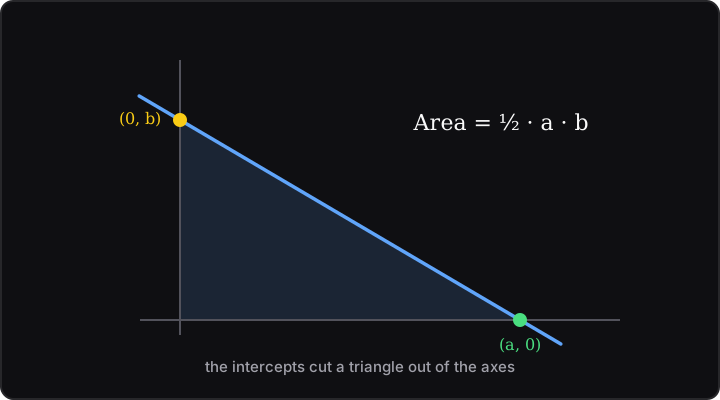
Where a line crosses each axis — the x and y intercepts — and the triangle those intercepts cut out of the axes, whose area follows from the base and height they hand you.
Triangle Centres
The closing constructions: the centroid, the circumcentre, and the orthocentre of a triangle — each found by intersecting lines you now know how to build, using midpoints, perpendicular slopes, and the meeting-point skills all together.
Know your gaps before the exam does
The MathsHelp course is everything you need for Leaving Cert Higher Level Maths, in one place. Smart testing pinpoints exactly where you are losing marks, explainer articles teach you the curriculum, an AI tutor works through your specific weaknesses, and real past papers — organised by topic, with guides — prove you are exam-ready.
- 20 articles on this topic
- 55 questions on this topic
- 1,300+ custom questions
- 280 explainer articles
- 12 years of past papers by topic