
Co-Ordinate Geometry of the Circle
Circles in co-ordinates: equations, tangents, chords, and how lines and circles meet — the payoff of the line topic.
Topic Importance
Co-ordinate geometry of the circle is where the spatial chain's line work pays off. It has appeared in 24 questions over the last 12 years — every single year — and, as the Paper Two overview noted, the questions are usually quite similar from year to year.

That similarity is the opportunity: once the line topic is in place, the circle questions reduce to a familiar set of moves — equations, tangents, intersections, chords — rehearsed on past papers until they are routine.
What the Topic Covers
The topic starts with the concept and equations of the circle: a circle is all the points a fixed distance — the radius — from a fixed point — the centre, and two equation forms capture that. Then a second way to pin a circle down: finding its equation from three points that lie on it.
Next come the lines that touch and cut: tangents to a circle at a point, their perpendicular partners the normals — continue the radius through the point of tangency and that line is the normal — and the general question of line–circle intersections, with its three cases.
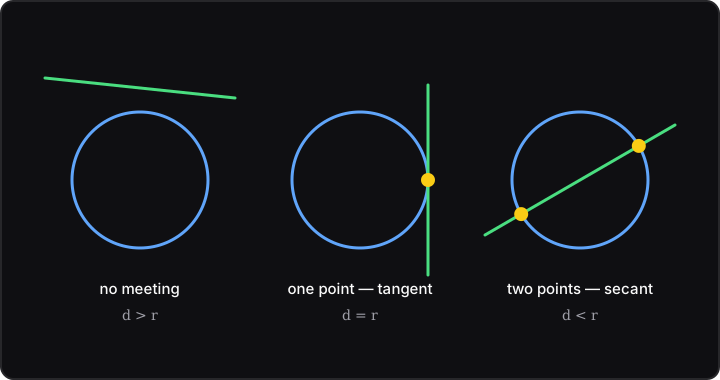
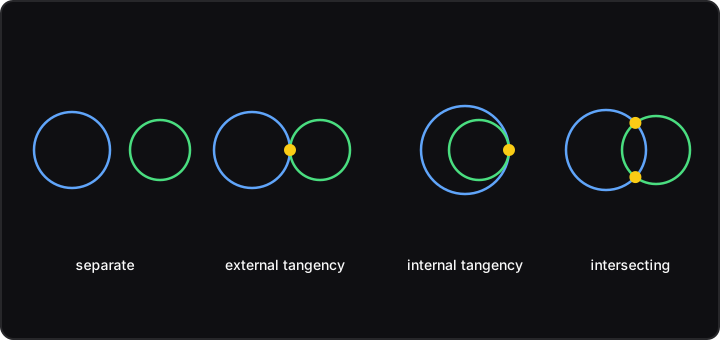
Building on the secant case come chords — the length of the cut a line makes through a circle — and finally the relationships between circles: separate, externally tangent, internally tangent, or intersecting at two points.
Find the centre and radius of the circle \(x^2 + y^2 - 6x + 4y - 12 = 0\).
Find the equation of the tangent to the circle \(x^2 + y^2 = 25\) at the point \((3, 4)\).
Exam Correlations
Geometry of the circle appears 24 times over 12 years, and its closest partners are exactly its neighbours in the spatial block: trigonometry with 5 shared questions and the line with 4, then the axioms and theorems on 2.
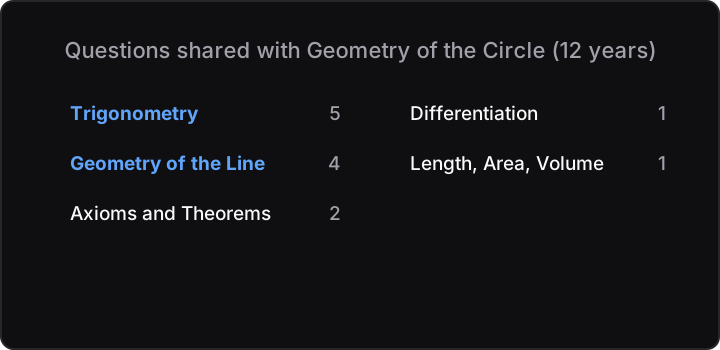
A note on the counts: "Differentiation" bundles Differentiation 1, 2, and 3. The line number is the bundling described in both the overview and the line article — one question with parts from each topic, because the concepts genuinely interlock. The trigonometry number reflects the triangles that radii and chords keep forming. The usual caveat applies to the single counts.
A circle question has appeared every year for 12 years, asking for broadly the same moves each time. With the line topic done, this is the most predictable substantial question in the spatial block.
Concept Connections
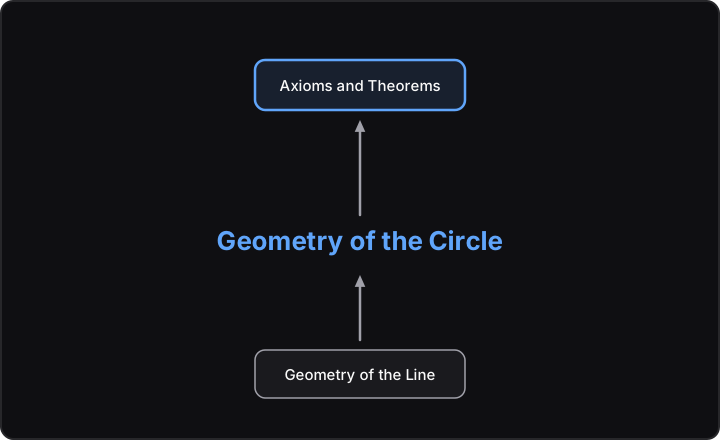
The circle sits near the end of the spatial chain: the line feeds in directly, and the axioms and theorems make light use of it afterwards.
Study Order
There are seven sub-topics in Geometry of the Circle: pin the circle down, then bring in the lines, then relate circles to each other. Click each step to see how they build.
The Concept and Equations of the Circle
The definition — all points a fixed distance from the centre — and the two equation forms that encode it: the centre-radius form, and the expanded general form.
The Circle from Three Points
A circle is also pinned down by any three points that lie on it: substitute each point into the general form and three equations determine \(g\), \(f\), and \(c\).
Tangents to Circles
The first meeting of the circle with the line topic: finding the equation of the tangent to a given circle at a given point — a line question, anchored by the radius meeting it at a right angle.
Normals
The tangent’s perpendicular partner: continue the radius on through the point of tangency, and that line is the normal. With perpendicular slopes from the line topic, it comes almost for free.
Line–Circle Intersections
The general picture, with three cases: no intersection, one point — the tangent — or two points, the secant that passes through. Which case you are in is decided by the distance from the centre to the line against the radius.
Chords
Building on the secant case: the segment a line cuts through a circle is a chord, and its length follows from the radius and the centre-to-line distance — the hypotenuse rule inside the circle.
Relationships Between Circles
The closing step widens to two circles: separate, externally tangent — touching once from outside — internally tangent — one inside the other, touching at the edge — or intersecting at two points. The distance between the centres, against the two radii, decides the case.
Know your gaps before the exam does
The MathsHelp course is everything you need for Leaving Cert Higher Level Maths, in one place. Smart testing pinpoints exactly where you are losing marks, explainer articles teach you the curriculum, an AI tutor works through your specific weaknesses, and real past papers — organised by topic, with guides — prove you are exam-ready.
- 12 articles on this topic
- 43 questions on this topic
- 1,300+ custom questions
- 280 explainer articles
- 12 years of past papers by topic