
Binomial
The n-choose-k numbers: counting selections, expanding brackets, and the first stepping stone into Leaving Cert probability.
Topic Importance
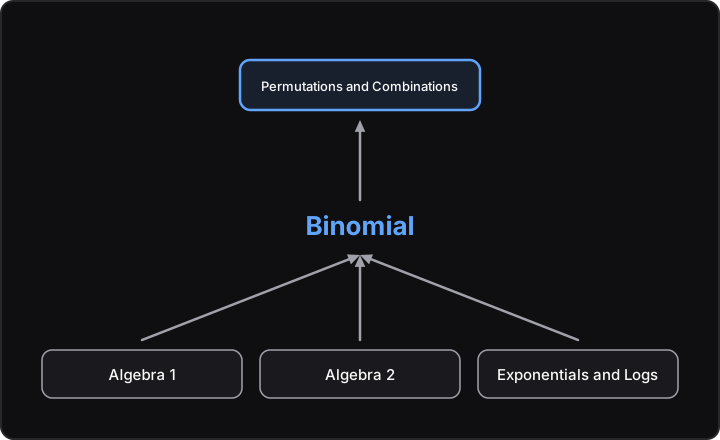
Binomial is the first link in the likelihood chain on Paper Two — the chain that runs binomial, then permutations and combinations, then probability. It is a short topic, but the probability questions that carry so many marks on this paper are built on it.
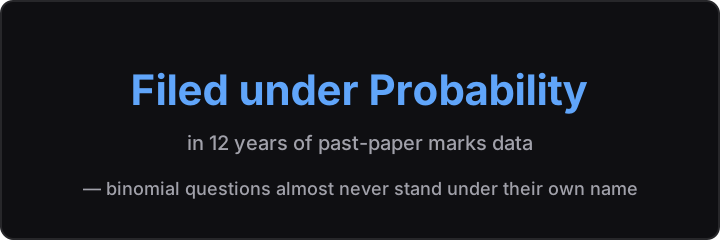
You will not find "binomial" headlining the marks tables, and that is the point: as the Paper Two overview explained, binomial content almost always appears inside questions categorised as probability. The marks are real — they are just collected somewhere else. Studying this topic is how you start collecting them.
What the Topic Covers
The topic starts with the concept: understanding combinations. The "n choose k" number counts the ways of choosing a set of things from a larger group — the idea everything else here is built on.
Then comes the binomial expansion: applying those numbers to expanding brackets. Raise \((x + y)\) to a power, and the coefficients of the resulting polynomial are exactly the combination numbers — laid out row by row in Pascal's triangle.
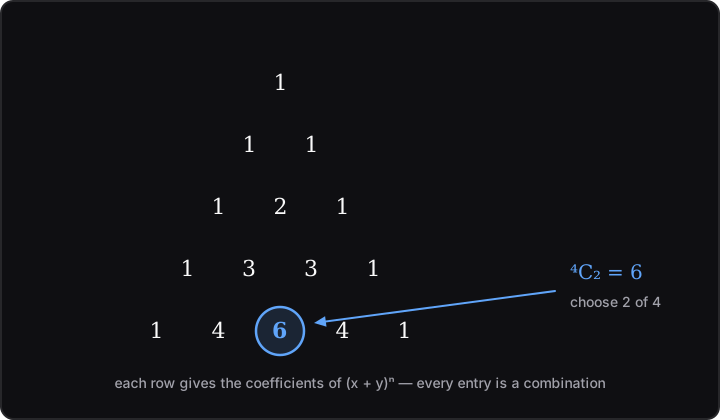
Finally, the topic ties into probability: the basics of odds and likelihood, and how the combination numbers combine with the odds of a single outcome to give the overall likelihood of a whole set of outcomes. This is the step that turns the topic into exam marks.
Find the coefficient of \(x^3 y^7\) in the expansion of \((x + y)^{10}\).
A fair coin is flipped 4 times. In how many ways can exactly 2 heads come up, and what is the probability of that happening?
Exam Correlations
This is the one topic in the series without a correlations table — because the past papers give it no rows of its own. Questions with binomial content generally fit under the probability topic, so the correlation data all accrues there.
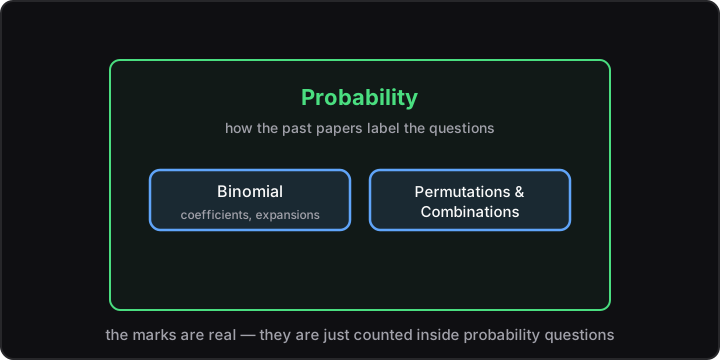
That categorisation tells you how the topic is examined. Binomial coefficients and expansions do not generally come up on their own; they appear in the context of a probability question — most often the repeated-trials kind, where the coefficient counts the ways a set of outcomes can happen. So every correlation binomial "should" have is inherited by probability instead.
Do not let the missing table read as missing marks. The binomial is inside the probability questions that appear every single year — studying it first is what makes those marks reachable.
Concept Connections
Binomial sits at the very start of the likelihood chain: three Paper One topics feed in, and it leads out to permutations and combinations.
Study Order
There are three sub-topics in Binomial: the concept, the expansion, and the application. Click each step to see how they build.
Understanding Combinations
Start with the concept: the combination number \(\binom{n}{k}\) counts the ways of choosing \(k\) things from \(n\). Everything in this topic — and the two topics after it — is this number put to work.
Understanding the Binomial Expansion
The combination numbers applied to factor expansion: raise \((x+y)\) to a power and, instead of multiplying the brackets out longhand, read the coefficients straight off — each one a combination, because it counts the ways of picking a \(y\) from the brackets. This is where the Algebra 2 bracket work pays off.
The Binomial in Probability
The payoff step: the basics of odds and likelihood, and then the tie-in — the combination number counts the ways a set of outcomes can occur, and multiplying by the odds of each way gives the overall likelihood. This is the machinery under the repeated-trials probability questions you will meet later in the chain.
Know your gaps before the exam does
The MathsHelp course is everything you need for Leaving Cert Higher Level Maths, in one place. Smart testing pinpoints exactly where you are losing marks, explainer articles teach you the curriculum, an AI tutor works through your specific weaknesses, and real past papers — organised by topic, with guides — prove you are exam-ready.
- 4 articles on this topic
- 15 questions on this topic
- 1,300+ custom questions
- 280 explainer articles
- 12 years of past papers by topic