
Sequences and Series
Arithmetic and geometric sequences and their sums: the formal machinery behind patterns, and the engine that financial maths runs on.
Topic Importance
Sequences and Series is the formal half of the patterns block on Paper One. It has appeared in 21 questions over the last 12 years — and every single one of those questions was shared with patterns. A pattern opens the question; the sequences and series machinery earns the rest of the marks.

This is one of the most predictable question types on the paper: recognise the sequence, name its variables, and apply the right term or sum formula. And the topic pays forward — the geometric series is the engine of Financial Maths, where compound interest and loan repayment questions are geometric series in disguise.
What the Topic Covers
The topic starts with the concept: a sequence is an ordered list of numbers built by a rule, with \(T_n\) naming the \(n\)th term. The first kind you study in detail is the arithmetic sequence — the same amount added each time, a formalised linear pattern.
Then comes the idea that gives the topic its double name: a series is the sum of the terms of a sequence so far. The same list of numbers can be read two ways.
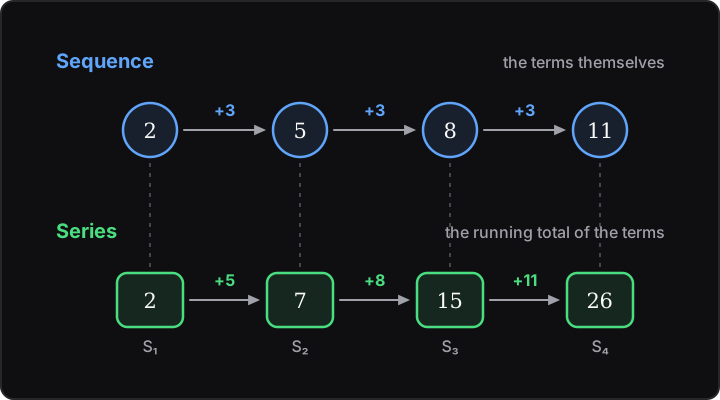
The arithmetic series comes with a sum formula and its own applications. Then the whole process repeats for the multiplicative type: geometric sequences — constant ratio, formalised exponential patterns — followed by the geometric series and its sum formulas.
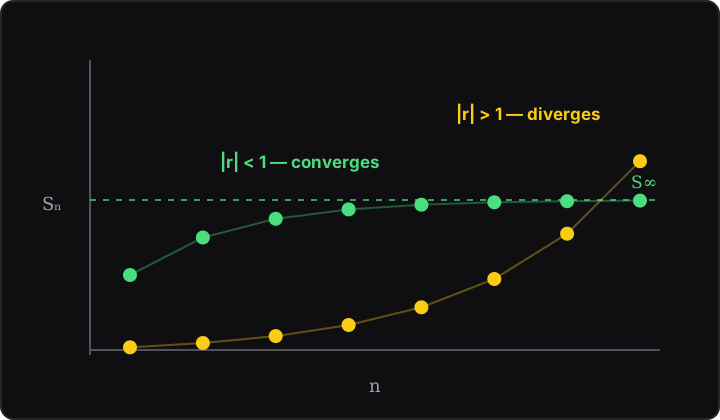
The topic closes with behaviour in the long run: whether a sequence converges or diverges as \(n\) grows, and the surprising result that an infinite series can add up to a finite number.
The arithmetic sequence \(2,\; 5,\; 8,\; \dots\) has first term \(a = 2\) and common difference \(d = 3\). Find the sum of the first 20 terms.
Evaluate \(\dfrac{1}{2} + \dfrac{1}{4} + \dfrac{1}{8} + \cdots\)
Exam Correlations
Sequences and series appears 21 times over 12 years, and the correlation table has the same headline as the Patterns article, seen from the other side: all 21 of those questions were shared with patterns. Algebra and induction follow far behind on 4 each.
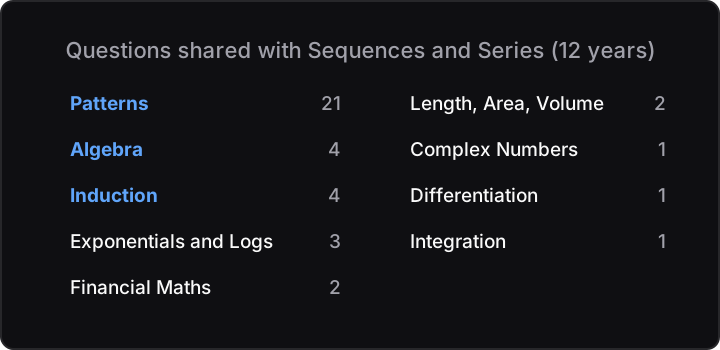
A note on the counts: "Algebra" bundles Algebra 1 and Algebra 2 together, and "Differentiation" bundles Differentiation 1, 2, and 3. The usual caveat — topics appearing in the same question does not always mean a deep mathematical link — barely applies here, because sequences genuinely are formalised patterns: examiners treat the two topics as one continuous story. One number understates its link: Financial Maths shows only 2 shared questions, because financial questions are counted as their own topic — but mathematically they lean on the geometric series throughout.
Studied straight after Patterns, this topic completes one of the most predictable question types on Paper One — and hands you the machinery that Financial Maths questions are built from.
Concept Connections
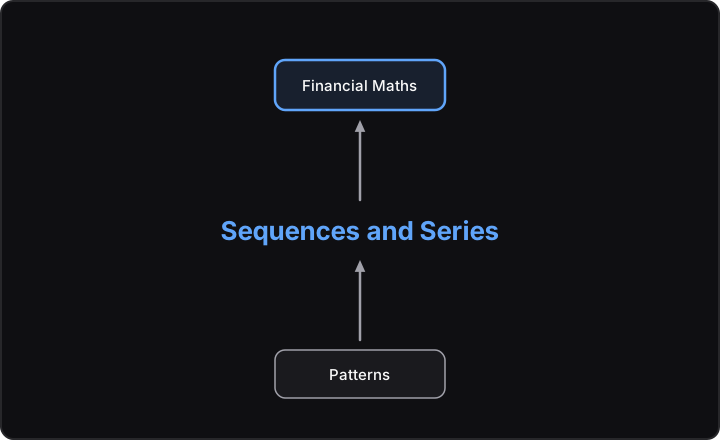
Sequences and series sits in the middle of a single clean chain: one topic feeds in, and one topic flows out.
Study Order
There are seven sub-topics in Sequences and Series, and they follow a deliberate rhythm: sequence, then series, for the arithmetic type — then the same again for the geometric type — then the long-run behaviour of both. Click each step to see how they build.
Introduction to Sequences
What a sequence is: an ordered list of numbers built by a rule, with \(T_n\) naming the \(n\)th term. The first examples are arithmetic sequences — the formalised linear patterns from the Patterns topic.
Arithmetic Sequences
The first sequence type in detail: a first term \(a\) and a common difference \(d\) added each step. The \(n\)th-term formula turns "keep adding" into a single expression you can evaluate directly — the substitution skill from evaluating patterns.
Arithmetic Series and Applications
The series idea arrives: \(S_n\) is the sum of the terms so far. For arithmetic sequences there is a closed formula, and this step also covers its applications — real quantities that accumulate by a constant amount.
Geometric Sequences
The rhythm repeats for the multiplicative type: a first term \(a\) multiplied by a common ratio \(r\) each step — the formalised exponential pattern, leaning on the powers from Exponentials and Logarithms. You learn to find the variables \(a\) and \(r\) from given terms and to evaluate any term.
Geometric Series and Sum Formulas
As step 3 did for arithmetic sequences, this step sums the geometric ones. This formula is the one Financial Maths will run on.
Convergence and Divergence of Sequences
With both types mastered, the questions turn to long-run behaviour: what happens to the terms as \(n\) grows without limit. Some sequences settle towards a value — they converge — and others grow without bound and diverge. For geometric sequences the common ratio decides which.
Convergence and Infinite Series
The final step puts convergence and series together: when the terms of a geometric sequence shrink fast enough, adding infinitely many of them gives a finite answer — the sum to infinity.
Know your gaps before the exam does
The MathsHelp course is everything you need for Leaving Cert Higher Level Maths, in one place. Smart testing pinpoints exactly where you are losing marks, explainer articles teach you the curriculum, an AI tutor works through your specific weaknesses, and real past papers — organised by topic, with guides — prove you are exam-ready.
- 7 articles on this topic
- 38 questions on this topic
- 1,300+ custom questions
- 280 explainer articles
- 12 years of past papers by topic