Building a Smart Study Plan for Paper One
The Leaving Certificate Higher Level Maths exam has two papers, and each paper covers a different set of topics. This guide looks at Paper One.
This is the first article in the Paper One series. Here we break down the paper overall. Breakdowns of specific topics, such as Algebra, are in the following articles.
By the end of it, you will be able to build a smart study plan for Paper One. The goal is simple: you want the most marks for the least study time. To do this, we will look at three things:
Marks
Which topics carry the most marks.
Hidden links
Which topics quietly help the others.
Study order
The best order to study them in.
So this is not just a list of what is on the paper. It shows you where to spend your study time, so that none of it is wasted.

But first, there is one idea to keep in mind the whole way through. The topics on this paper are linked. A topic may look small on its own, but its real value is often much bigger. This is because many topics are hidden inside other topics. A topic that looks minor can still add a lot of marks to the big topics. As we go through the list, watch for these links — they will shape how you study.
Differentiation
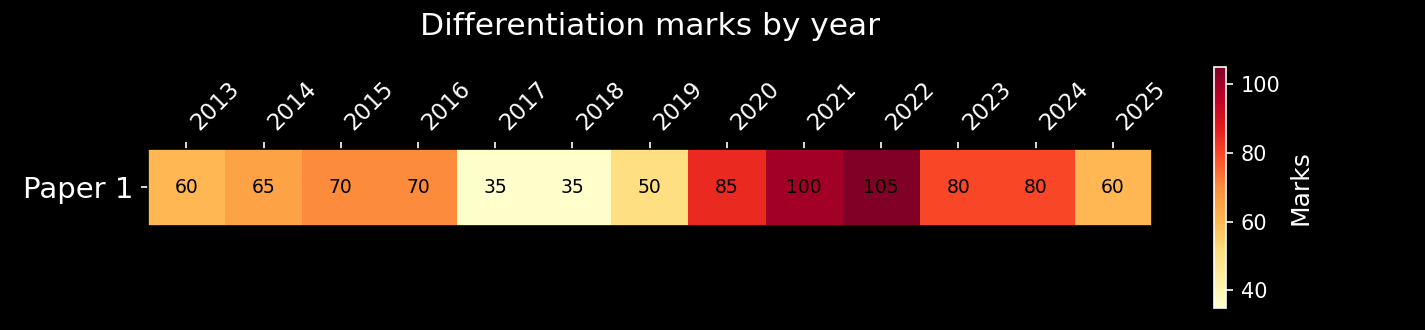
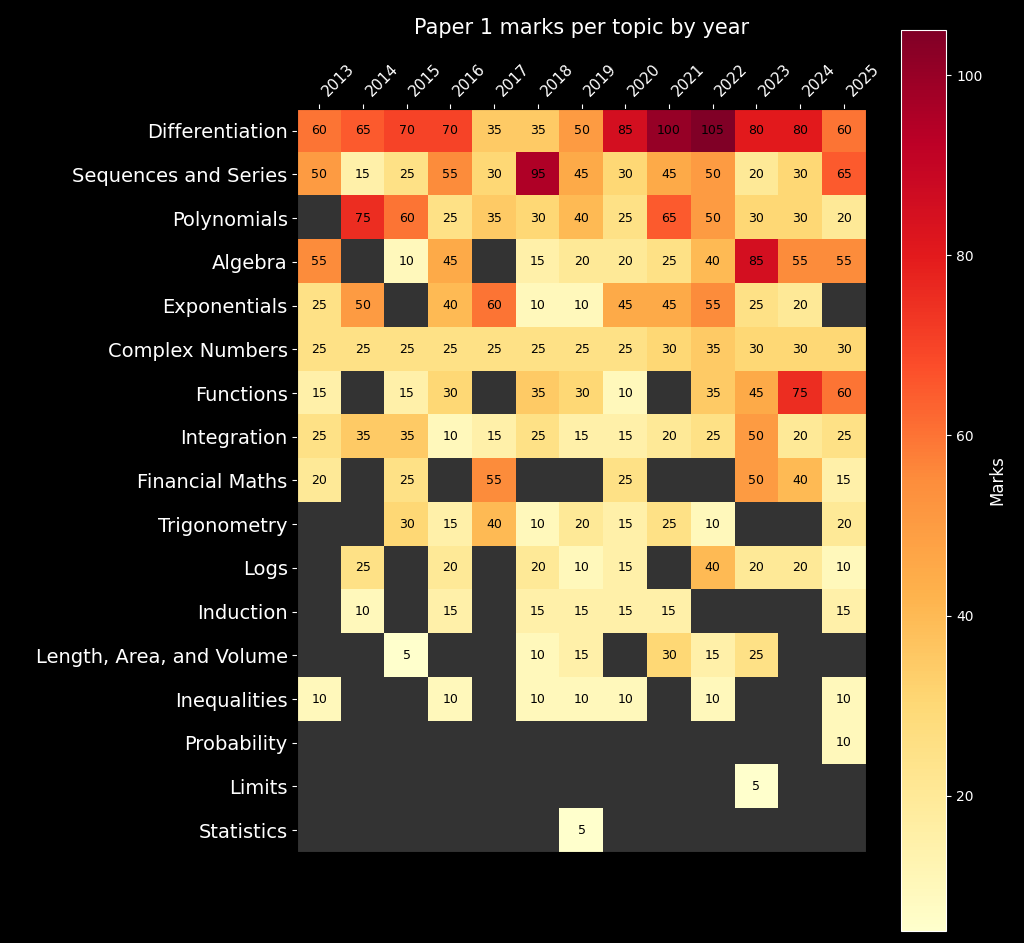
The most important topic on Paper One is differentiation. It comes up every year. Often it is the biggest topic on the whole paper. It stands well above the rest.
But there is something you need to know. To get full marks in differentiation, you also need other topics. Some topics look small on their own, yet they add a lot of value through differentiation.
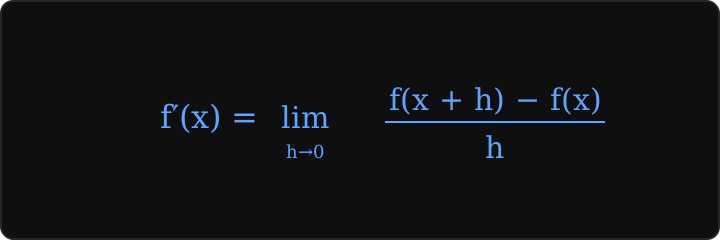
Take limits. At first, limits look like they came up only once, and for very few marks. But that is misleading. Limits are part of differentiation itself. Differentiation from first principles comes up a lot, and that method is built on a limit. So limits matter far more than the headline numbers suggest.
Sequences and Series
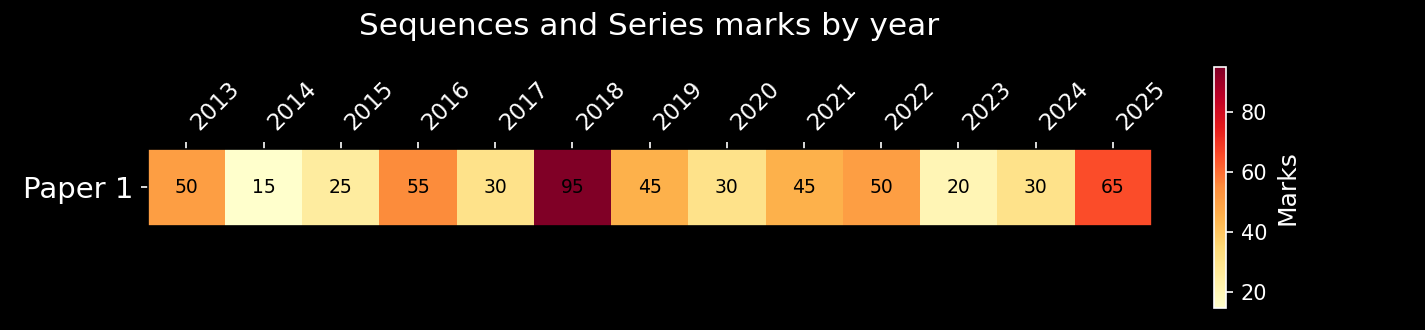
The next most important topic is sequences and series. This one is also linked to limits. When you work with infinite series, you are using the idea of a limit.

So once again, a topic that looks small on its own is really running underneath the topics that matter most.
Polynomials
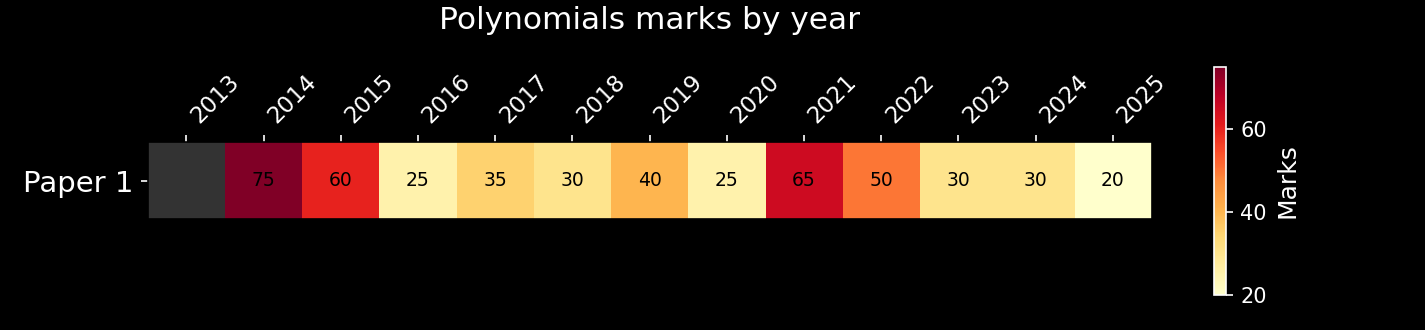
Polynomials are another very important area. They matter a lot because of how they link to other topics, but they also matter on their own.
Finding the roots of a quadratic is a very common question. Finding the roots of a cubic, when you are given a quadratic to start from, is also very common.
But polynomials show up in other topics too. This is most clear in the calculus topics: differentiation and integration.
Here is an example. You might be asked to find the turning points of a cubic. To do this, you find where the derivative equals zero. So this is a differentiation question first. You take the derivative, and you get a quadratic. But where does a quadratic equal zero? At its roots. So hidden inside that differentiation question is a polynomial question.
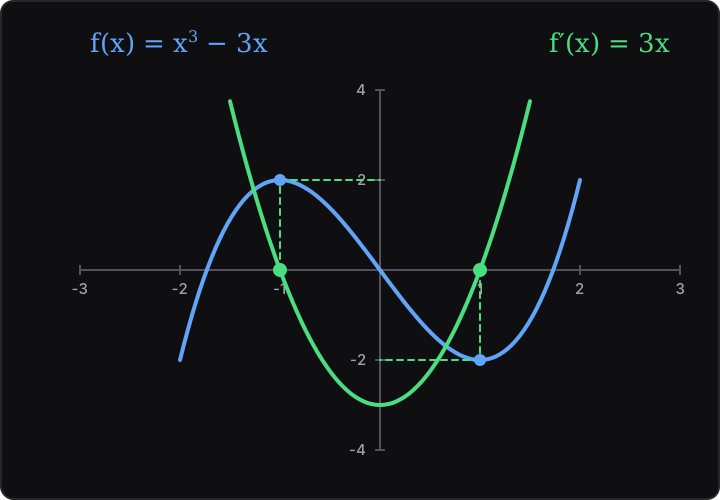
This is important to notice. Some topics get joined inside one question. When you pick a question in the exam, expect to use a few topics at once. For example, say you are strong at differentiation and want to win a lot of marks there — then you must also be strong at polynomials.
Algebra
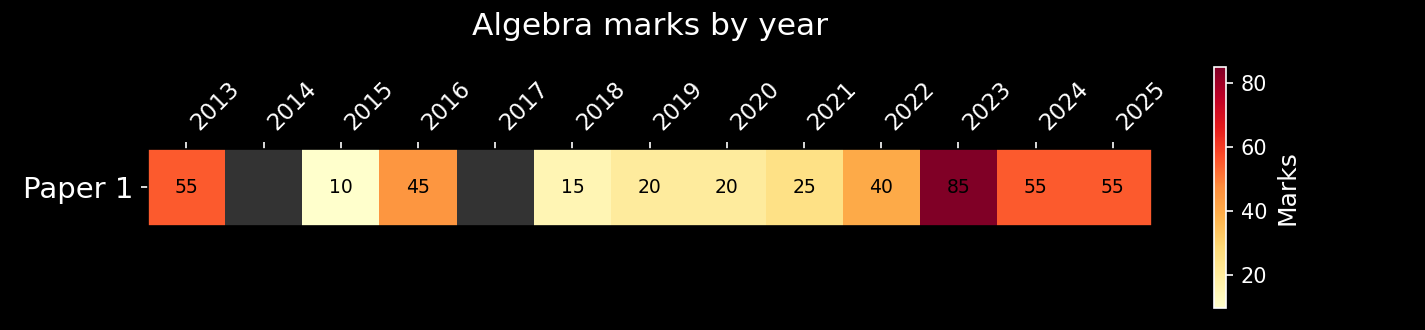
Algebra is, of course, very common. Sometimes it looks like algebra did not come up. That is misleading. It just means there was no question that was purely algebra.
The truth is that algebra is part of almost everything. Algebra is moving variables around the two sides of an equation or an inequality. It shows up in nearly every kind of question.
So algebra is the base knowledge you need to answer all the other questions. That makes it very important. If you do not know algebra well, you will struggle with everything else. And on top of that, it also carries a fair share of marks on its own.
Exponentials and Logarithms
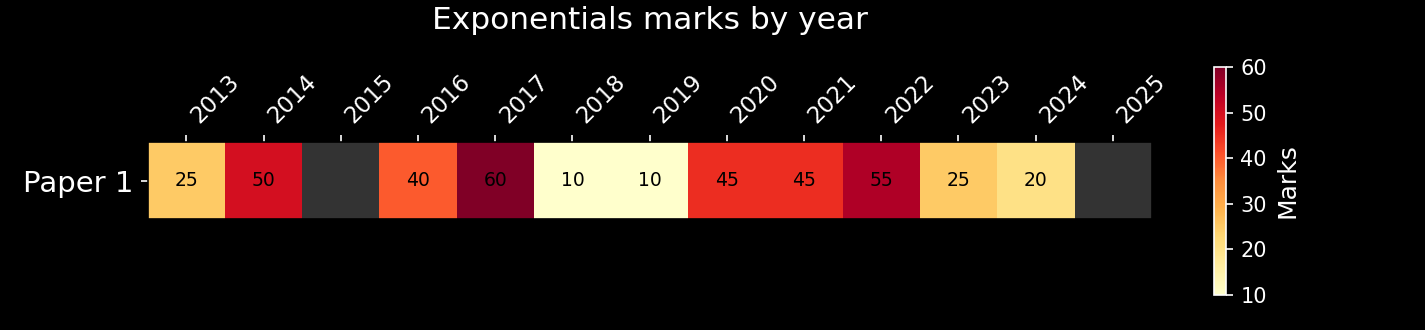
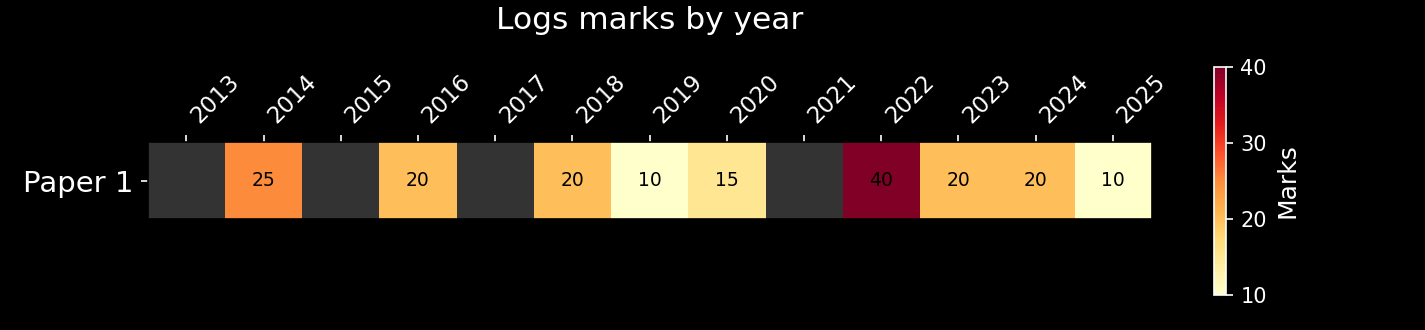
Next we have exponentials. This is again a very common topic. It turns up across the whole paper.
Where there seem to be gaps, it is because the exponentials are hidden inside other questions. Sequences and series, for example, usually involve some kind of power. A differentiation or integration question may ask you to work on an exponential, and then do more with the result. Financial maths uses exponentials too, because interest rates are written as exponentials.
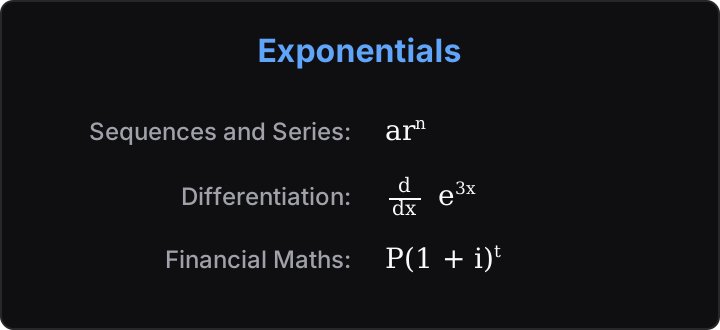
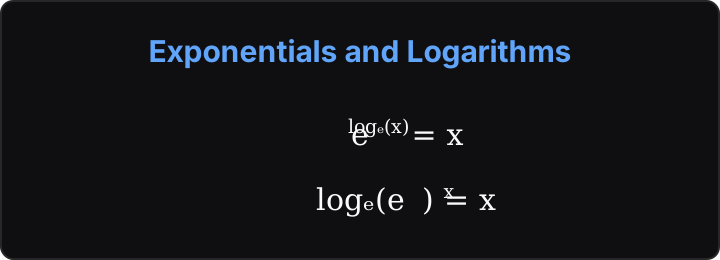
Exponentials also tend to come bundled with logarithms. As a rule, if a question has a lot of exponentials, it will have a lot of logarithms too. The two travel together.
So the combined topic of exponentials and logarithms is essential for Paper One.
Complex Numbers
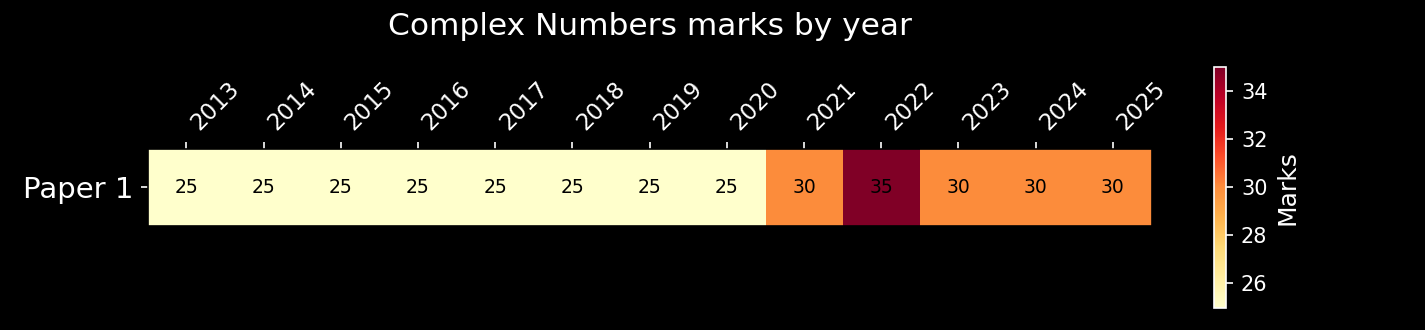
Next we come to complex numbers. This is another topic that is always there. It is always on Paper One, and it is always worth about the same number of marks. You will usually get one complex number question.
The nice thing about this topic is that it mostly stays on its own. It does not mix much with the other topics. So if you want to score well in complex numbers, you can mostly get away with just knowing complex numbers. Other ideas will not get in the way too much.

There are a few small exceptions, mainly a bit of trigonometry. But the overlap is very minor.
Functions
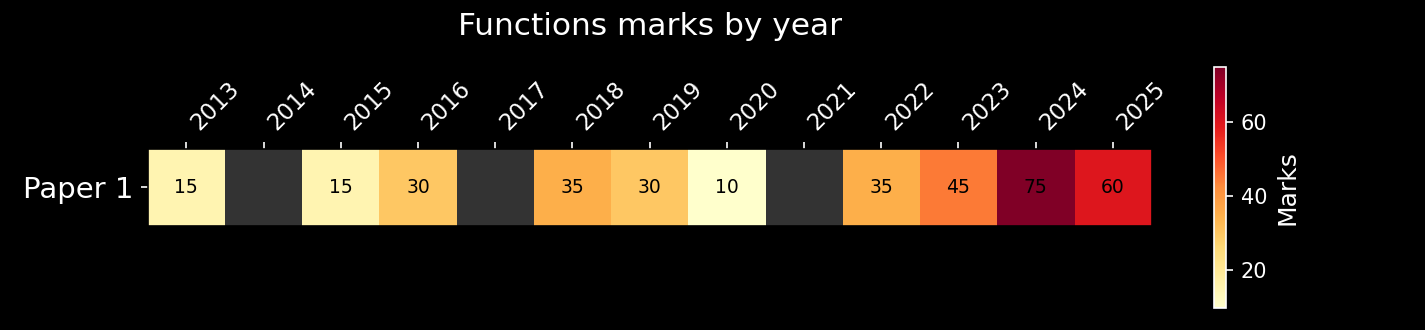
Functions are another very common topic. This one is also fairly self-contained.
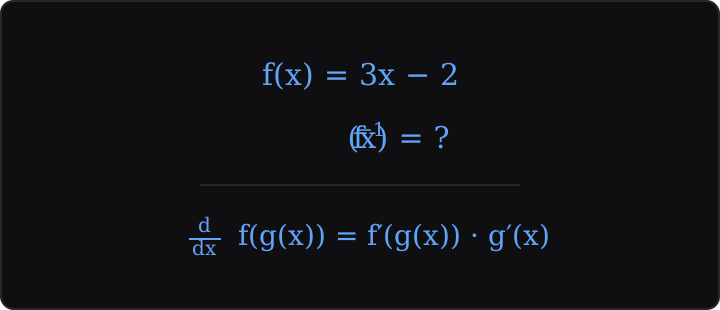
Usually you will be asked to do something like find the inverse of a function. Or you might work with a function placed inside another function.
This topic does not mix much with the others. There is some link to the chain rule in differentiation, so you may need a bit of function knowledge inside a differentiation question. But not much.
This makes functions a good topic to know. You can grab some solid marks without needing many topics at the same time.
Integration
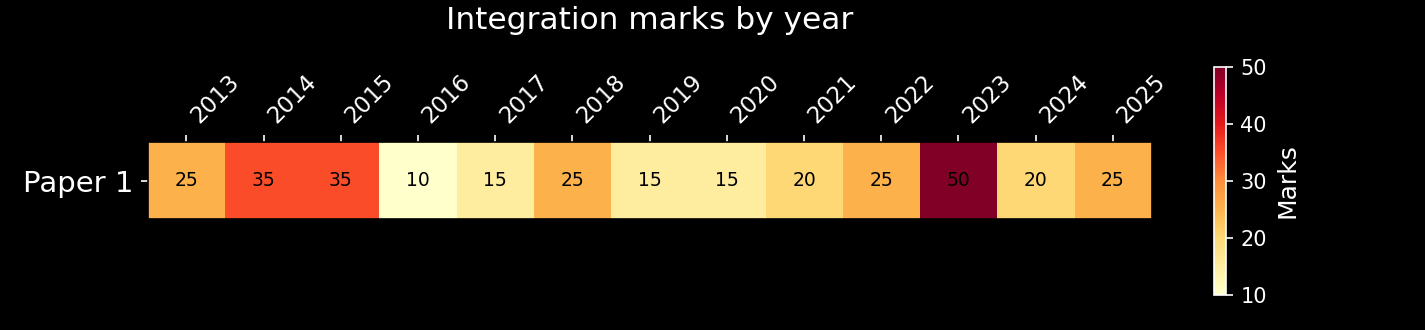
The next big topic is integration. Like differentiation, it is always there and it is important. It is not quite as important as differentiation, though.
Students also tend to find it a bit trickier. That makes it well worth focusing on.
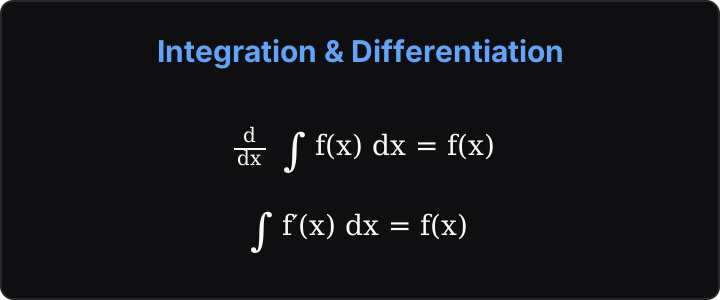
Integration is usually joined with differentiation in some way. Sometimes there is a separate question that is mostly integration. But often it is mixed into a differentiation question. So if you plan to take on a differentiation question and aim for top marks, you will most likely need some integration to do it.
Financial Maths
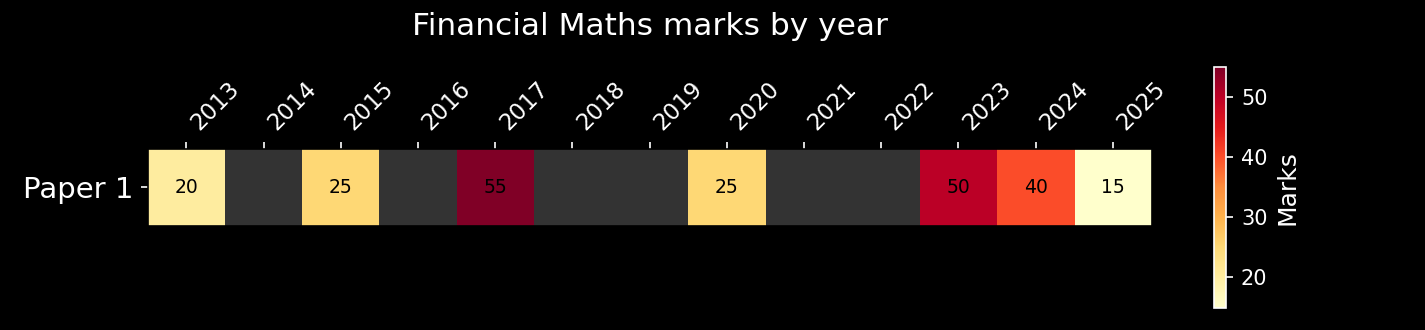
Financial maths is more common than it looks. Some questions use financial maths ideas without being labelled that way. This happens a lot inside exponential and logarithm questions.
Financial maths is really just using these ideas for business and money. There are a few special terms that are not maths in themselves, like gross profit and net profit. The main challenge of financial maths is turning these business terms into maths. Once you have done that, the maths is basically just exponentials and logarithms.
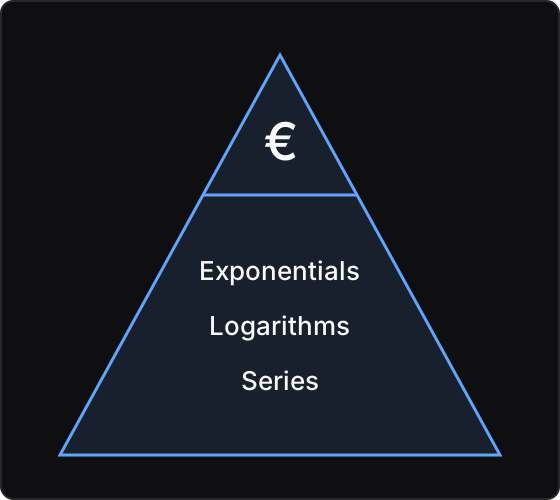
So if you are good at exponentials and logarithms, financial maths becomes easy. And you should be aiming to be good at them anyway, since they show up on every paper and are worth a fair share of marks. You only need a small amount of extra work to learn the business terms. That is all — the actual maths is something you already know.
Induction
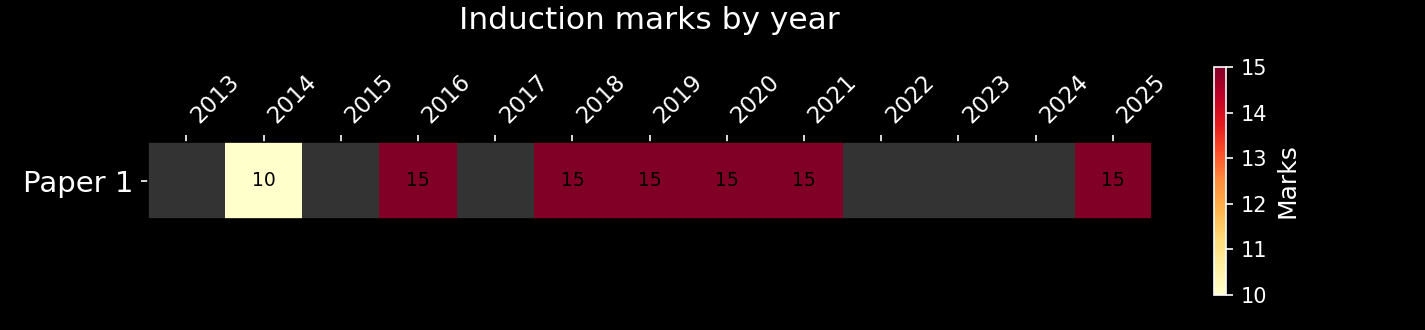
Induction is very common. It is usually not worth a huge number of marks, but it shows up often, so it is well worth knowing.
You can pick up a lot of marks just by knowing the format of a proof by induction. The actual maths in each step depends on the question, and it can change a lot. It might be algebra, exponentials, or something else entirely.
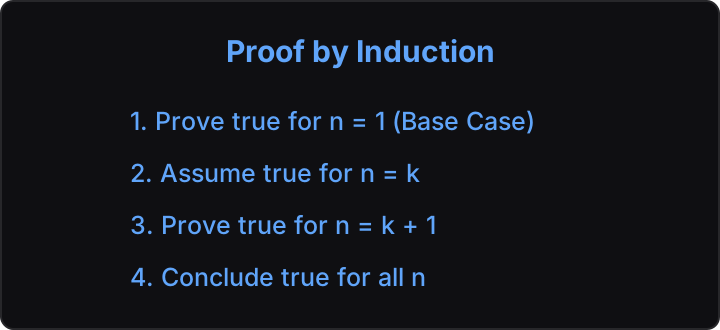
Here is the key point: you can win a good number of marks just for knowing the steps of the proof. This is true even if you cannot fully finish every step for that question.
Length, Area and Volume
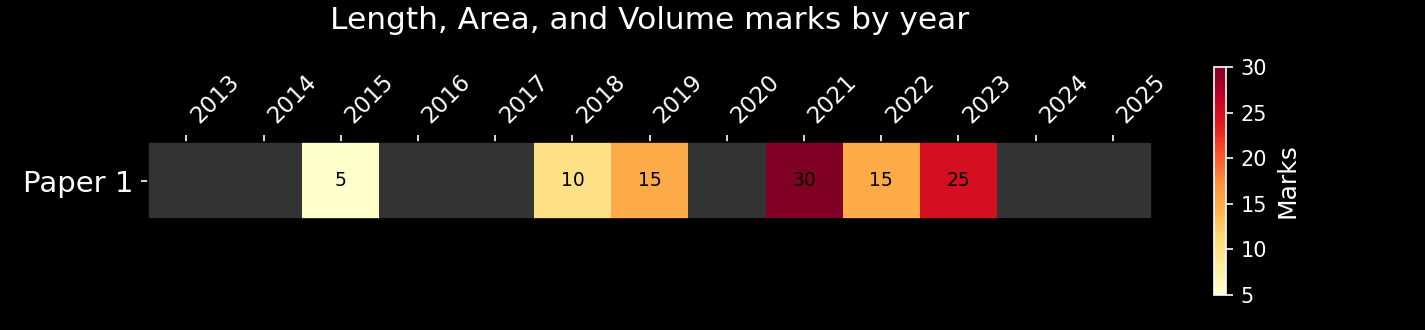
Length, area and volume is not a hugely important topic, but it is fairly common.
You can pick up some good marks here, and it is quite easy. You have been working with shapes since you were a child. So this is a good question for simply getting some easy points on the board.
Inequalities
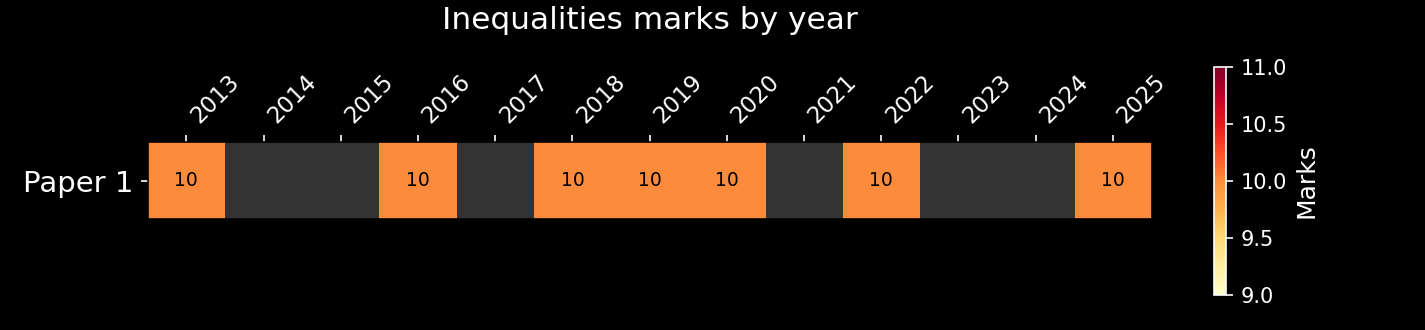
Inequalities are also quite important. They may look like they are worth few marks, but they often mix with other topics.
A common example is polynomial inequalities. Here you end up with an inequality that looks a lot like a roots equation. The only difference is the sign. Instead of the quadratic being equal to zero, it is greater than or less than zero. From there, you mostly do the usual work of finding the roots. Then you add an inequality at the end.
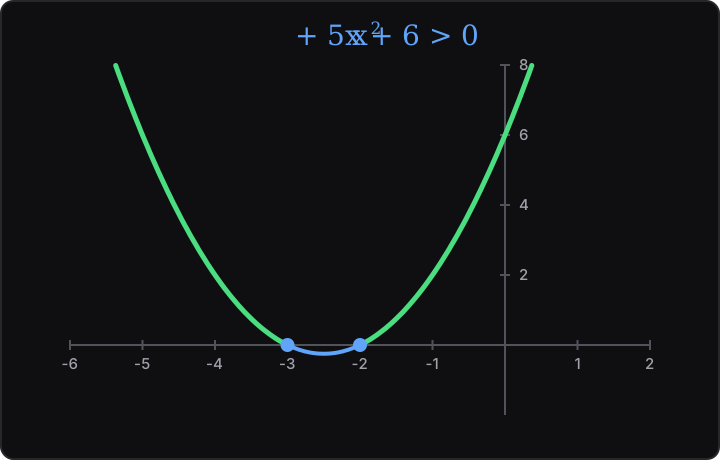
So inequalities are more common, and worth more, than they look. This is because they are so often hidden inside another topic, such as polynomials.
A Note on Paper Two Topics
You will see a couple of topics here that are really Paper Two topics: probability and statistics.
Do not think they can catch you out on Paper One. In real terms, there might be one small concept in one question that uses a very basic idea from probability or statistics. It will be something you already know as common knowledge.
We mention them here so you are not surprised if you see them. But it is very rare, and it will not seriously test your knowledge of probability or statistics.
Building Your Study Plan
When you build your study plan for Paper One, your priorities should start at the top of this list. Then work your way down to the bottom.
But there is a catch. You may first need to first study some of the topics that look unimportant. This is because they help you tackle the topics that are worth more marks.
Let us put this together as an order of study.
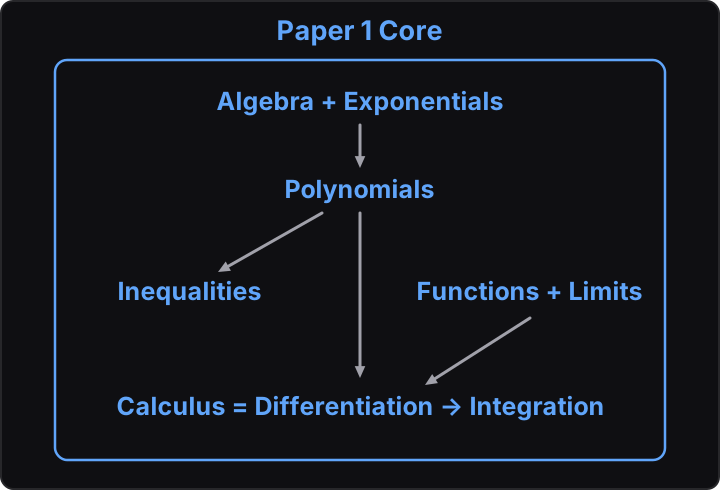
You can study algebra and exponentials on their own. Once you have those two, you unlock polynomials. These three topics together are very important. In many ways, they are the foundation of Paper One.
Next, once you have mastered polynomials, you can move on to inequalities. These are a very reliable type of question. They are usually asked in terms of polynomials.
Now take functions and limits as another block. Combine that with your algebra, exponentials, and polynomials block. Together, these unlock differentiation. And once you have mastered differentiation, you can study integration.
That covers a huge part of Paper One, with a lot of guaranteed questions. So remember that order:
- Algebra and exponentials unlock polynomials.
- Polynomials unlock inequalities.
- Polynomials, plus functions and limits, unlock calculus.
- Calculus means differentiation first, then integration.
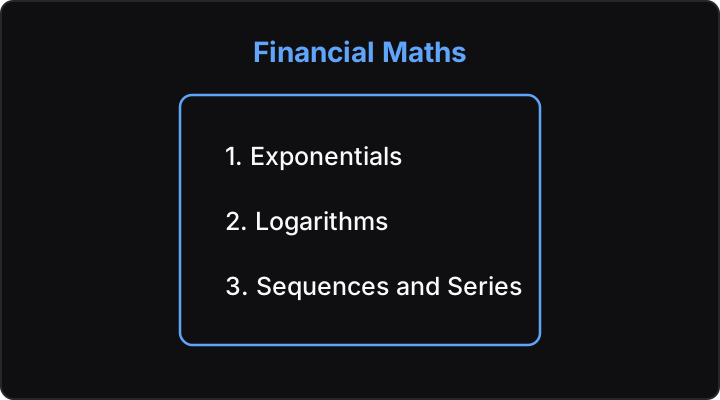
Financial maths is also an important topic. To tackle it, study a few blocks first. Start with exponentials, then logarithms. Then do sequences and series. Once you have those three — exponentials, logs, and sequences and series — financial maths should be straightforward.
The last link is complex numbers. As we said, a little basic trigonometry before you start may help, but it is probably not essential. Your study of complex numbers will likely cover the trigonometry you need.

A few other topics, such as induction, and length, area and volume, are fairly independent. So you can tackle these on their own.

Know your gaps before the exam does
The MathsHelp course is everything you need for Leaving Cert Higher Level Maths, in one place. Smart testing pinpoints exactly where you are losing marks, explainer articles teach you the curriculum, an AI tutor works through your specific weaknesses, and real past papers — organised by topic, with guides — prove you are exam-ready.
- 1,300+ custom questions
- 280 explainer articles
- 12 years of past papers by topic
What Comes Next
You now know what order to take when studying the Paper One curriculum.
From here, we look at one topic at a time. For each topic, we break down the important ideas, show how many marks they usually carry, and show how they connect to each other. That way, when you study, you will know how to organise the material.
You will see which subtopics build on which, which ideas build on which, and which ones tend to go together. So if you plan to answer a question on a certain part of a topic, you will usually know what else comes with it.
← Back to the Study Plan Guide Overview