
Patterns
Linear, quadratic, and exponential growth: the pattern-spotting skill that every sequences and series question starts with.
Topic Importance
Patterns is the doorway into the sequences-and-series block of Paper One. It has appeared in 21 questions over the last 12 years — and every single one of those questions was shared with sequences and series. Pattern-spotting is how those questions start.

The topic itself is short and approachable: recognising how a list of numbers is growing, describing that growth with an expression, and using the expression to predict later values. But its real importance is what it unlocks — the arithmetic and geometric sequences of Sequences and Series are formalised patterns, so the work you do here is the first half of one of the most reliable question types on the paper.
What the Topic Covers
The topic starts with the concept: what a pattern actually is — a list of values growing according to a rule. The first rule you meet is the simplest: a linear pattern, where the same amount is added each time, so the difference between terms is constant.
From there the growth rules get richer. In a quadratic pattern the difference itself changes — but at a constant rate, which links back to the quadratic expressions you met in Algebra 2. In an exponential pattern each term is multiplied by the same amount, the constant-ratio growth you know from Exponentials and Logarithms.
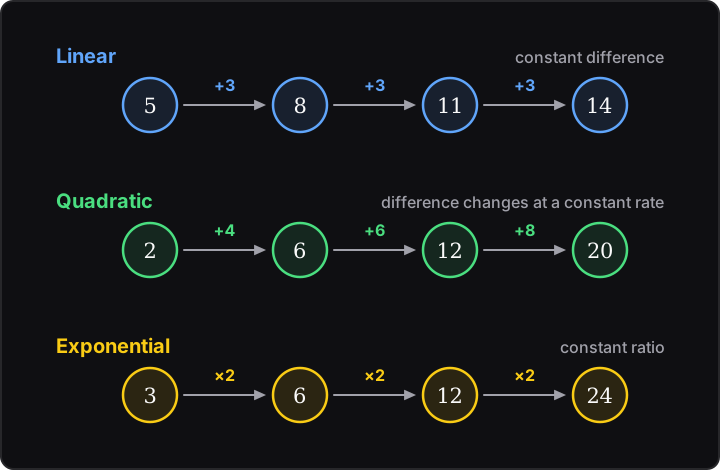
Then comes evaluating patterns: once a pattern is written as an expression in \(n\) — a formula for the \(n\)th term — finding any value is just substitution. Finally, applications of patterns puts the machinery into real contexts: population growth, finances, and other quantities that grow by a rule.
The first four terms of a pattern are \(5,\; 8,\; 11,\; 14\). What type of pattern is this, and what is the next term?
A pattern has \(n\)th term \(T_n = 3n + 2\). Find the value of the 20th term.
Exam Correlations
Patterns appears 21 times over 12 years, and its correlation table has one headline: all 21 of those questions were shared with sequences and series. Algebra and induction follow far behind on 4 each.
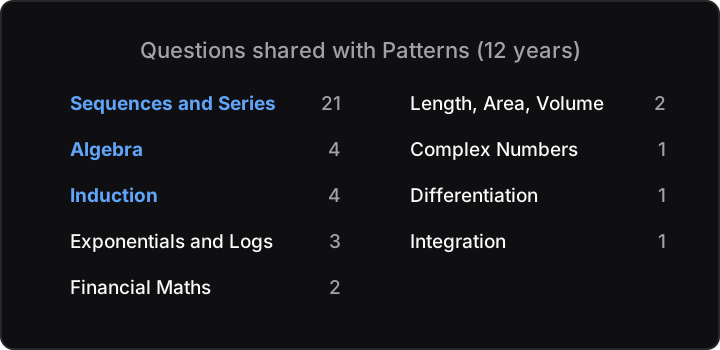
A note on the counts: "Algebra" bundles Algebra 1 and Algebra 2 together, and "Differentiation" bundles Differentiation 1, 2, and 3. The usual caveat — topics appearing in the same question does not always mean a deep mathematical link — barely applies here, because the link genuinely is deep: examiners treat the two topics as one continuous story. A question typically opens by showing you a pattern and asking you to describe it, then moves into sequences and series territory for the remaining parts.
You cannot bank the marks from a patterns question without sequences and series — and you cannot start a sequences and series question without pattern-spotting. Studying the two back to back is effectively one investment covering some of the most predictable marks on Paper One.
Concept Connections
Patterns sits on a short, clean chain: two topics feed in, and one topic flows out.
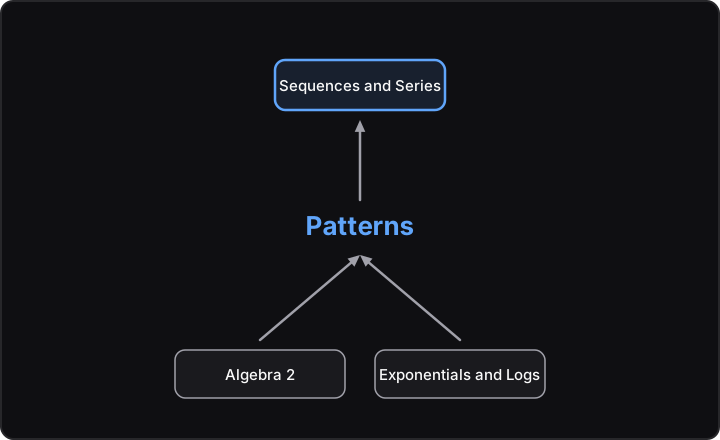
And outward, one arrow — but it is a big one.
Study Order
There are five sub-topics in Patterns, and the order matters: the three pattern types come first, then the skills that use them. Click each step to see how they build.
What a Pattern Is + Linear Patterns
Start with the concept: a pattern is a list of values growing by a rule. The first rule is linear — the same amount is added each time, so the difference between consecutive terms is constant.
Quadratic Patterns
The next growth rule: the difference between terms is no longer constant, but it changes at a constant rate — the second difference is constant. These patterns have quadratic \(n\)th terms, which is where the Algebra 2 polynomial work comes in.
Exponential Patterns
The third rule swaps addition for multiplication: each term is multiplied by the same amount, so the ratio between terms is constant. The \(n\)th term is a power, built on the concept of the exponential from Exponentials and Logarithms.
Evaluating Patterns
With the three types recognised, patterns become expressions: a formula in \(n\) giving the value of the \(n\)th term. Evaluating one is substitution — put in the value of \(n\), get the term. This is the skill that turns "describe the pattern" into "predict term 50".
Applications of Patterns
Finally, the pattern types get put to work in real contexts — population growth, finances, and other quantities that grow by a rule. The skill is matching the situation to the right pattern type from steps 1–3, then evaluating it as in step 4.
Know your gaps before the exam does
The MathsHelp course is everything you need for Leaving Cert Higher Level Maths, in one place. Smart testing pinpoints exactly where you are losing marks, explainer articles teach you the curriculum, an AI tutor works through your specific weaknesses, and real past papers — organised by topic, with guides — prove you are exam-ready.
- 7 articles on this topic
- 34 questions on this topic
- 1,300+ custom questions
- 280 explainer articles
- 12 years of past papers by topic