
Number Systems
The foundation topic: number sets, order of operations, and the vocabulary that every other topic in the course is built upon.
Topic Importance
Number systems might seem like one of the simplest topics in the course — and in a sense, it is. You won't find many exam questions devoted exclusively to number sets or order of operations.
But here is why it matters. Number systems is the foundation that everything else builds upon. Every topic in mathematics requires you to know what kinds of numbers you are working with. When an induction problem asks you about the smallest natural number, you need to know what natural numbers are. And whenever you are evaluating any expression — whether it is in algebra, functions, integration, or financial maths — you are relying on order of operations, which lives right here in number systems.
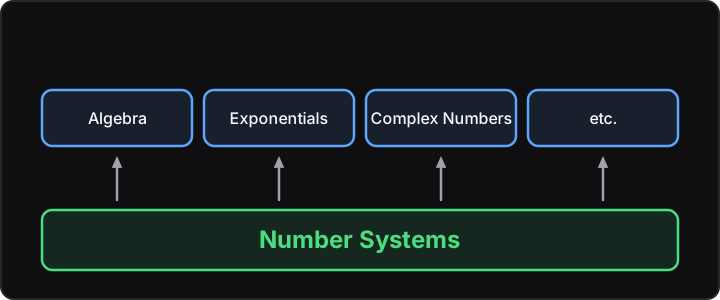
So while this topic rarely carries marks on its own, weaknesses here cause errors everywhere else. Master it early and you will avoid countless mistakes down the line.
What the Topic Covers
Number systems is about two core things: understanding the different types of numbers, and knowing how to evaluate expressions correctly.
For number types, you will need to recognise and work with the standard number sets: natural numbers, integers, real numbers, and complex numbers.
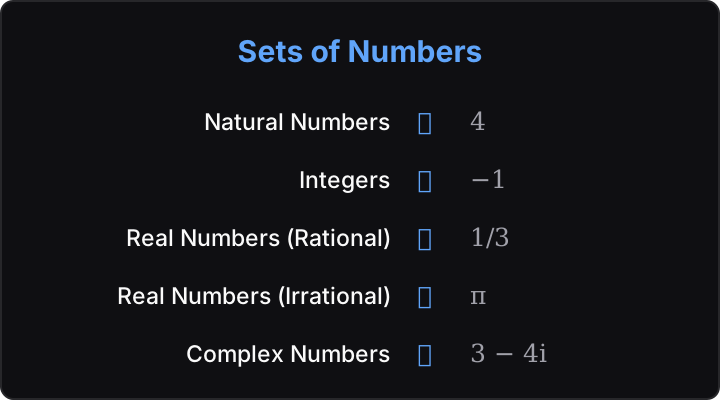
Studying this topic, you will encounter questions like these — they test whether you can read set notation and classify numbers correctly:
If \(x \in \mathbb{N}\), what kind of number is \(x\)?
Which of the following are all natural numbers?
For expressions, you will apply BIMDAS — brackets, indices, multiplication and division, addition and subtraction — to evaluate correctly.
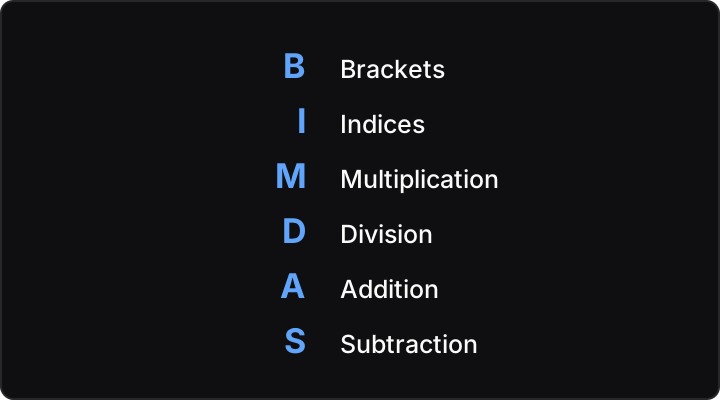
Without a calculator, evaluate \(\left(\left(3+2\right) \times \frac{6}{5}\right)^2\).
Exam Correlations
Because number systems rarely appears as a standalone exam topic, we cannot say how often it appears with other topics in the way we do for most of the curriculum. However, its concepts — particularly evaluating expressions — appear embedded in questions across nearly every topic: algebra, functions, integration, financial maths, and more.
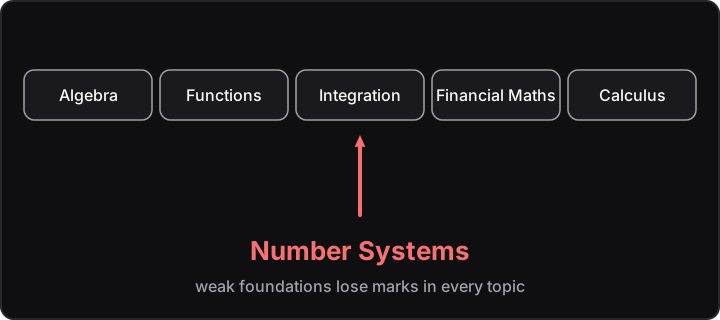
This means number systems has an unusual relationship with your marks. You will not typically gain marks directly from number systems knowledge — but you can certainly lose marks if your foundations here are weak. An order of operations error in a calculus problem costs you just the same as anywhere else. And misunderstanding what n ∈ ℝ means can derail an entire question.
Think of number systems as hidden infrastructure: invisible when it is working, but the cause of problems when it is not.
Concept Connections
Number systems sits at the very beginning of the mathematical hierarchy. It has no prerequisites — you need to understand number types and basic operations before you can do anything else.
The most direct connection is to induction. Mathematical induction is a proof technique specifically for statements about natural numbers. The base case requires identifying the smallest natural number, and the inductive step requires understanding what the next natural number means. If you do not know what the ℕ set represents, you cannot set up an induction proof correctly.

Beyond this structural connection, the skill of evaluating expressions appears throughout the course. When you substitute a value into a function, check an integral by differentiation, or compute a compound interest formula, you are using order of operations. All of these trace back to what you learn here.
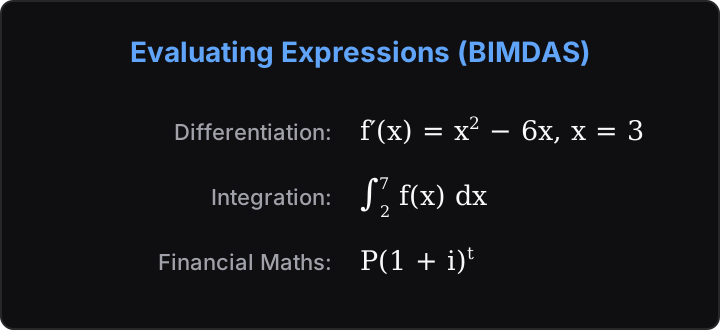
Number systems also prepares you for complex numbers later in the course. Understanding that complex numbers extend the real numbers — and recognising when a number does or does not belong to ℝ — becomes essential when you are working with the imaginary unit and complex arithmetic.
Study Order
This topic is small and hierarchical, so the study order is straightforward.
Start with number types. Begin with natural numbers — the simplest set, just the counting numbers. Then extend to integers by adding zero and negatives. Then extend to real numbers by adding fractions, decimals, and irrationals. Finally, understand complex numbers as the further extension that includes imaginary numbers.
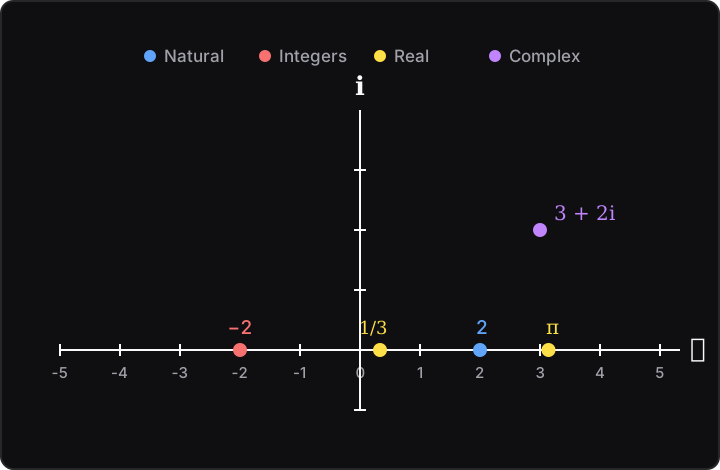
Focus on two things: recognising which numbers belong to which sets, and understanding that each type of number is a subset of a broader set.
Then move to order of operations. Once you understand what numbers are, learn how to combine them correctly. BIMDAS is the rule. Practice with nested brackets, since these require working from the inside out.
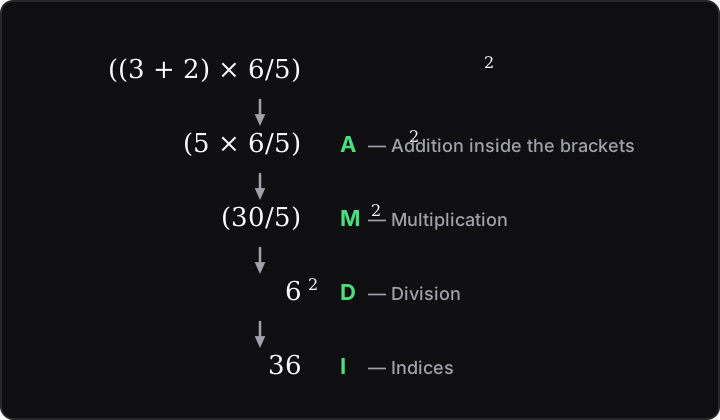
The key mistakes to avoid: working strictly left to right without respecting the hierarchy, and assuming multiplication always comes before division, when they actually share the same priority.
With number types and order of operations solid, you have the foundational vocabulary and skills that every other topic depends upon. A small investment that pays dividends throughout the entire course.
Know your gaps before the exam does
The MathsHelp course is everything you need for Leaving Cert Higher Level Maths, in one place. Smart testing pinpoints exactly where you are losing marks, explainer articles teach you the curriculum, an AI tutor works through your specific weaknesses, and real past papers — organised by topic, with guides — prove you are exam-ready.
- 2 articles on this topic
- 22 questions on this topic
- 1,300+ custom questions
- 280 explainer articles
- 12 years of past papers by topic