
Length, Area, and Volume
Perimeter, area, surface area, and volume — climbing a dimension at a time, with the formulas provided and the marks for applying them.
Topic Importance
Length, Area, and Volume is the measurement topic of Paper One. It has appeared in 9 questions over the last 12 years, and it comes with a gift: the formulas are printed in the tables book. The marks are not for remembering them — they are for recognising which one a situation needs and applying it cleanly.

It is also one of the most self-contained topics on the paper: almost nothing needs to be studied before it. That makes it a flexible piece of any study plan — and its formulas keep paying after it is done, because they are the raw material of the rate-of-change questions in differentiation.
What the Topic Covers
The topic climbs a dimension at a time. It starts in one dimension with perimeter — the length of a shape's boundary — first for the basic shapes, then for circles (circumference), hexagons, and arcs.
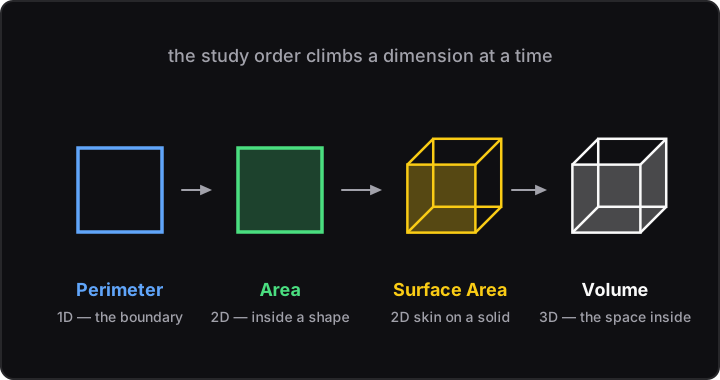
Then two dimensions: the area of 2D shapes, built up in the same way — basic shapes first, then triangles and hexagons, then circles. Moving to solids, surface area stays two-dimensional (the skin of a 3D shape) before volume completes the climb into the third dimension.
The topic ends with measurement problems: applied questions about tolerance, where a margin of error in a measured length becomes a margin of error in an area or volume.
Find the total surface area and the volume of a cylinder with radius 3 cm and height 10 cm.
The side of a cube is measured as \(5\,\text{cm}\), accurate to within \(0.1\,\text{cm}\). Find the maximum possible error in the calculated volume.
Exam Correlations
Length, area, and volume appears 9 times over 12 years, and its strongest partner by a clear margin is differentiation, with 6 shared questions. Exponentials and logs (4) and Algebra 1 (3) follow.
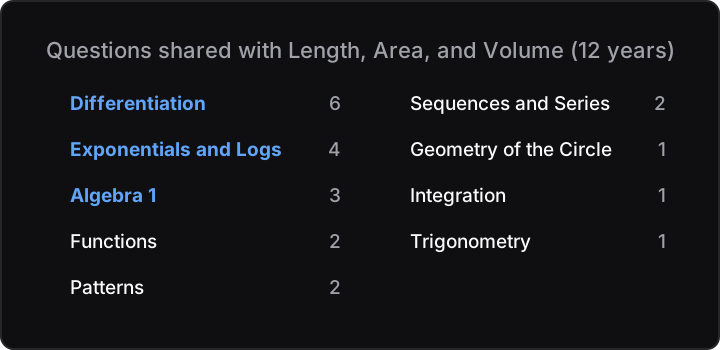
A note on the counts: "Differentiation" bundles Differentiation 1, 2, and 3 — and that 6 is no accident. The rates-of-change-of-shapes questions in Differentiation 3 differentiate exactly these volume and surface area formulas, so the two topics keep landing in the same question. Algebra 1 appears here as itself rather than inside an "Algebra" bundle. The usual caveat applies to the rest of the table: a shared question or two says little about a deep link.
This topic's marks are doubly efficient: the measurement questions themselves are formula applications with the formulas provided, and the same formulas are the entry ticket to the shape questions inside differentiation.
Concept Connections
Length, Area, and Volume is nearly standalone: the only real prerequisite is Algebra 1, and nothing needs to be studied after it. You can slot it into a study plan almost anywhere.
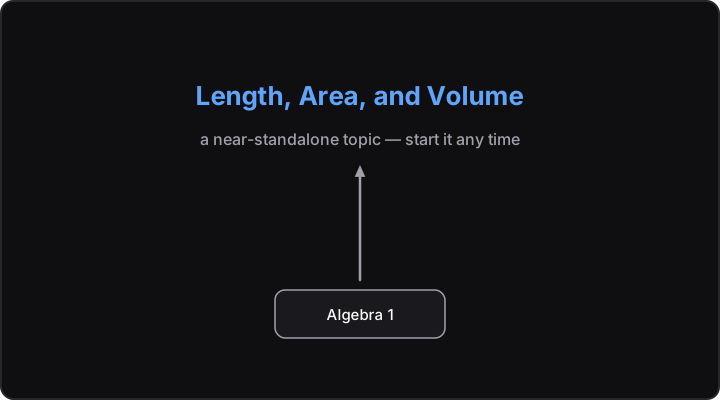
And outward? Nothing depends on it as a prerequisite — though as the correlations show, its formulas resurface inside differentiation questions, so having them fluent pays off beyond the topic itself.
Study Order
There are eight sub-topics in Length, Area, and Volume, and the order follows the dimensions: one-dimensional perimeter, two-dimensional area, the surfaces of solids, three-dimensional volume, and finally the applied measurement problems. Click each step to see how they build.
Understanding Perimeter
The starting point, in one dimension: what a perimeter means, and the perimeters of the basic shapes — squares, rectangles, triangles.
Perimeter and Circumference
The same idea on curvier boundaries: the circumference is just the perimeter of a circle, and with it come hexagons and arcs — perimeters assembled from pieces.
Area of 2D Shapes
Up a dimension: from the length of the boundary to the space inside it, starting with the basic shapes whose areas multiply out directly.
Areas of Triangles and Hexagons
The more complicated 2D shapes, built from the basic ones — a triangle as half a rectangle, a hexagon as assembled triangles.
Area of Circles
The area chapter closes with the circle, completing the pair with the circumference from step 2.
Surface Area of 3D Shapes
Solids enter, but the measurement is still two-dimensional: the surface area is the skin of a 3D shape, found by summing the areas of its faces — every face a shape from the earlier steps.
Volume of 3D Shapes
The climb completes in three dimensions: the space inside a solid. The formulas build on the areas beneath them — a cylinder's volume is its circular base swept through its height.
Measurement Problems and Tolerance
The applied finale: real measurements carry a margin of error, and this step asks how an error in a length feeds through the formulas — if a cuboid's side is only known to within a tolerance, how far off could the volume be? It uses every formula from the earlier steps, now with ranges instead of exact values.
Know your gaps before the exam does
The MathsHelp course is everything you need for Leaving Cert Higher Level Maths, in one place. Smart testing pinpoints exactly where you are losing marks, explainer articles teach you the curriculum, an AI tutor works through your specific weaknesses, and real past papers — organised by topic, with guides — prove you are exam-ready.
- 9 articles on this topic
- 43 questions on this topic
- 1,300+ custom questions
- 280 explainer articles
- 12 years of past papers by topic