
Integration
The second half of calculus: reverse differentiation, areas under curves, and the applications that close out the chain.
Topic Importance
Integration is the second half of calculus. It has appeared in 26 questions over the last 12 years — and like differentiation, it is always there. As we saw in the Paper One overview, students tend to find it a bit trickier, which makes it well worth focusing on.

It rarely stands alone: integration is usually joined with differentiation in some way. Sometimes there is a separate question that is mostly integration, but often it is mixed into a differentiation question — so if you plan to take on a differentiation question and aim for top marks, you will most likely need integration to finish it.
What the Topic Covers
The topic starts with the concept: integration as the reverse of differentiation. One idea deserves emphasis from the very beginning — the constant of integration. When you differentiate, any constant disappears, so functions that differ only by a constant share the same derivative. Reversing that, the integral cannot know which constant you started with — that is what the \(+\,c\) is for.
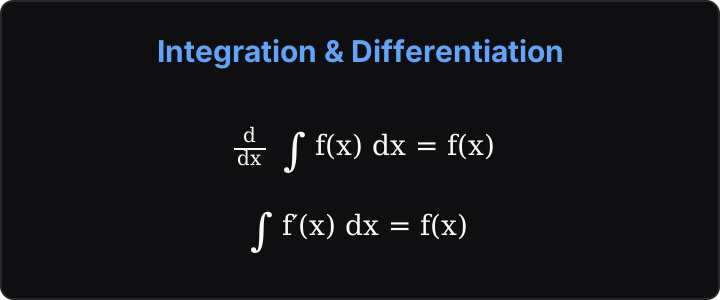
From there come the rules — factoring out constants, sums and differences — which combine into polynomial integration, mirroring the differentiation case. Then the expression types broaden to trig functions and exponentials and logarithms, each reversing the derivatives you already know.
That covers the theory; then come the applications. The definite integral finds the area under a curve between two values — and with start and end values in play, the \(c\)s cancel out.
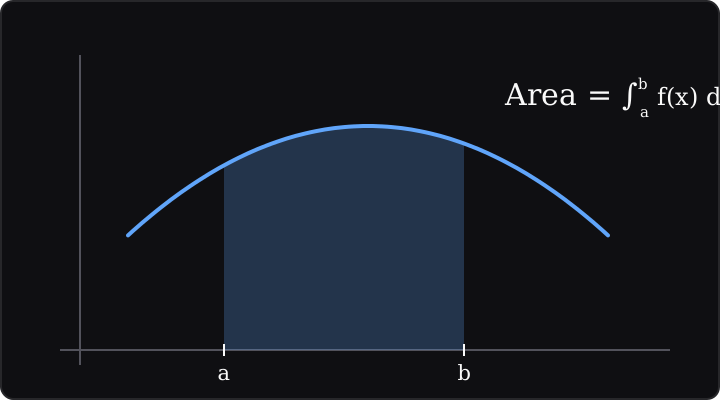
The area idea then extends in three directions: the average value of a function, the area a curve encloses beside the y-axis (found by integrating the inverse function), and areas in different quadrants, where absolute values are needed. Finally, kinematics runs the differentiation applications in reverse.
Find the total area enclosed between \(y = -x\) and the x-axis from \(x = 0\) to \(x = 4\).
Exam Correlations
Integration appears 26 times over 12 years, and its exam life is dominated by one partner: differentiation, with 18 shared appearances. Algebra (11) and functions (7) follow.
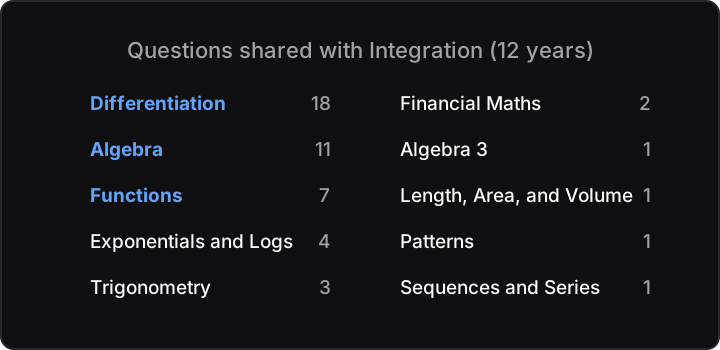
That differentiation number is the story of the topic. The two halves of calculus are usually examined together — a part (a) that differentiates, a part (b) or (c) that integrates, or a check of one using the other. The usual caveat about co-occurrence applies, but here the mathematical link genuinely is deep: they are reverse operations.
As noted in the differentiation articles: for top marks on a differentiation question, you will most likely need some integration to finish it — and vice versa.
Concept Connections
The lead-in to integration is Differentiation 3 — and that is mostly it. The other feeders you might expect (polynomials, trigonometry, exponentials and logs) all lead into differentiation first, so by the time you arrive here they are assumed.
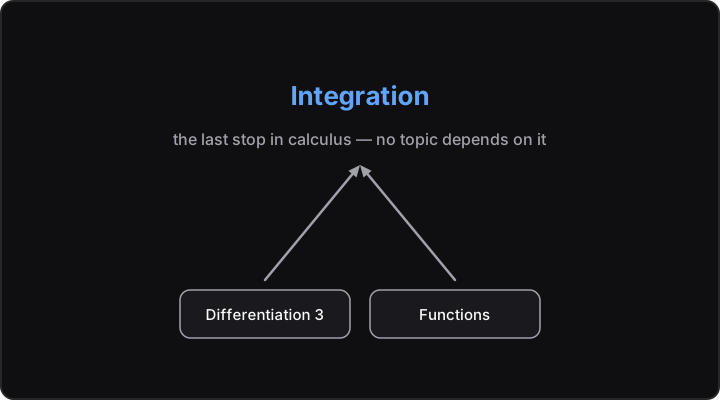
And outward? Nothing. Integration is the final topic of calculus — no other topic depends on it. Once it is done, the whole calculus chain, from algebra through differentiation, is complete.
Study Order
There are ten sub-topics in Integration: five of theory, then five of applications that stack on top. Click each step to see how they build.
Integration as Reverse Differentiation
Start with the concept: the integral undoes the derivative. And because differentiating a constant gives zero, functions differing only by a constant have the same derivative — so every indefinite integral carries a \(+\,c\) to stand for the constant you cannot recover.
Constant and Sum Rules
The combining rules, mirroring differentiation: constants factor out, and a sum or difference can be integrated term by term.
Polynomial Integration
Combine the rules and you can integrate any polynomial, just as combining the differentiation rules unlocked polynomial differentiation.
Trigonometric Functions
Reverse the trig derivatives you learned in Differentiation 1.
Exponentials and Logarithms
The same again for exponential and log forms — the last of the theory steps.
Areas Under Curves
The first application: integrating between start and end values gives the area under the curve. With limits in play, the \(c\)s cancel out — which is why definite integrals do not carry one.
Average Value of a Function
Builds directly on areas: divide the area by the width of the interval and you get the average height — which is the average value of the function.
Areas Beside the y-axis
Instead of the area above the x-axis, the area the curve encloses with the y-axis. You find it by taking the inverse of the function — from the Functions topic — and integrating that.
Areas in Different Quadrants
So far the picture has been the upper-right quadrant. Below the x-axis, the integral comes out negative — integrate \(y = -x\) from \(0\) to \(4\) and you get \(-8\), a nonsense value for an area. Where a function cuts the x-axis, split the integral and sum the absolute values of each piece.
Kinematics
The reverse of the differentiation applications: integrate acceleration to get velocity, and velocity to get displacement.
Know your gaps before the exam does
The MathsHelp course is everything you need for Leaving Cert Higher Level Maths, in one place. Smart testing pinpoints exactly where you are losing marks, explainer articles teach you the curriculum, an AI tutor works through your specific weaknesses, and real past papers — organised by topic, with guides — prove you are exam-ready.
- 10 articles on this topic
- 31 questions on this topic
- 1,300+ custom questions
- 280 explainer articles
- 12 years of past papers by topic