
Induction
Proof by induction: one fixed template, practised on the three classic example types in order of increasing difficulty.
Topic Importance
Induction is the proof topic of Paper One. It has appeared in 7 questions over the last 12 years — a small count, but with an unusual property: the method is identical every single time. Learn the template once, practise it on the classic example types, and an induction question becomes some of the most collectable marks on the paper.

It is also the topic where you prove things rather than compute them — most often the sum formulas you met in Sequences and Series. That is why it sits near the end of the study order: the statements you prove are drawn from the topics that came before.
What the Topic Covers
The topic starts with the concept: proof by induction and the steps involved. Prove a statement for a starting value (the base case), then prove that if it holds for one value \(k\), it must hold for the next value \(k+1\) (the induction step). Together those two facts topple every case in turn — the domino picture.
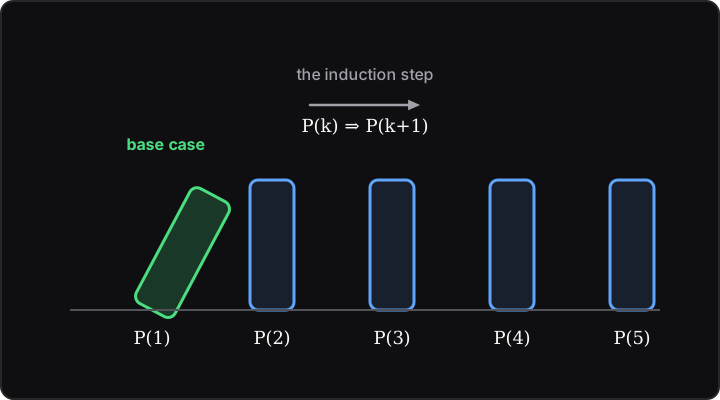
After the concept, the topic is organised around three classic example types, each one a sub-topic and each a step up in difficulty: a sum example (proving the formula for \(1 + 2 + \cdots + n\)), a divisibility example (proving \(3^n - 1\) is divisible by 2), and an inequality example (proving \(n! \geq 2^n\) from \(n = 4\) onwards).
Prove by induction that \(1 + 3 + 5 + \cdots + (2n - 1) = n^2\) for all \(n \in \mathbb{N}\).
Prove by induction that \(8^n - 1\) is divisible by 7 for all \(n \in \mathbb{N}\).
Exam Correlations
Induction appears 7 times over 12 years, and its closest partners are exactly the topics whose results it proves: patterns and sequences and series, with 4 shared questions each.
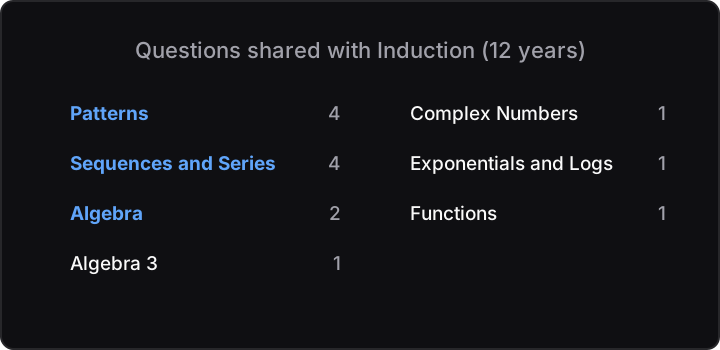
A note on the counts: "Algebra" bundles Algebra 1 and Algebra 2 together, while Algebra 3 — inequalities — is counted separately. The usual caveat about co-occurrence applies less than usual here: the link to patterns and sequences and series is genuine, because the statement an induction question asks you to prove is very often a sum formula for a series. The scattering of single shared questions across other topics reflects induction's nature — a proof method can be pointed at a statement from almost any topic.
Induction marks reward method, not discovery: every proof follows the same fixed template. Few topics offer marks this predictable for this little content — four sub-topics and one reusable structure.
Concept Connections
Induction has more feeders than any topic this size, because a proof can draw on concepts from almost anywhere — too many to list in full. The ones that matter most are the algebra blocks and exponentials.
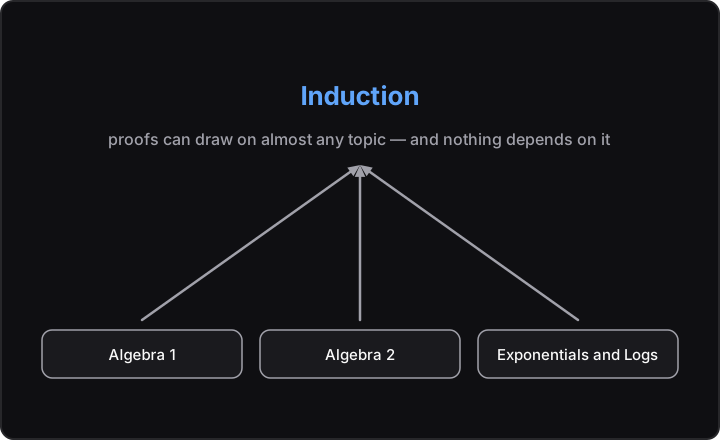
And outward? Nothing. Induction is not a prerequisite to anything else — it is a capstone that exercises the topics before it.
Study Order
There are four sub-topics in Induction: the method itself, then three example types in order of increasing difficulty. Click each step to see how they build.
The Concept and the Steps
What proof by induction is, and the fixed template every proof follows: prove the base case, assume the statement for \(n = k\), use that assumption to prove it for \(n = k + 1\), and conclude it holds for all \(n\). Every later sub-topic is this template applied to a different kind of statement.
The Sum Example
The friendliest first proof: the formula for the sum of the first \(n\) natural numbers — the arithmetic series result you met in Sequences and Series. The induction step is pure Algebra 1: add the next term to the assumed sum and rearrange into the target form.
The Divisibility Example
A step up: proving a divisibility fact rather than an equation. The trick is using the power rules to split \(3^{k+1} - 1\) so that the assumed fact about \(3^{k} - 1\) appears inside it — the assumption is used less directly than in the sum example.
The Inequality Example
The hardest of the three: proving an inequality, where the reasoning runs on the comparison skills from Algebra 3 — and the base case is not \(n = 1\), because the statement only becomes true from \(n = 4\) onwards. Chosen last because it demands the most care with the induction step.
Know your gaps before the exam does
The MathsHelp course is everything you need for Leaving Cert Higher Level Maths, in one place. Smart testing pinpoints exactly where you are losing marks, explainer articles teach you the curriculum, an AI tutor works through your specific weaknesses, and real past papers — organised by topic, with guides — prove you are exam-ready.
- 4 articles on this topic
- 28 questions on this topic
- 1,300+ custom questions
- 280 explainer articles
- 12 years of past papers by topic