
Functions
Domains, ranges, evaluation, composition, and inverses — the notation the rest of the course is written in.
Topic Importance
Functions has appeared in 23 questions over the last 12 years of past papers — a steady, reliable presence on Paper One.
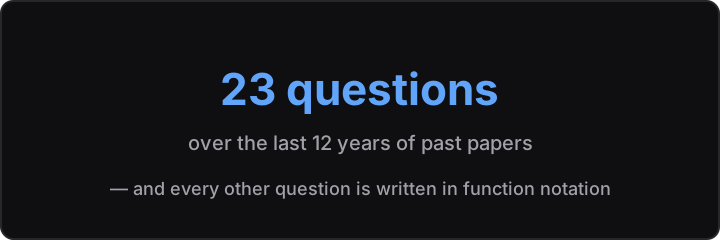
But the real reach of this topic is bigger than its own questions. Like number systems, functions is everywhere: nearly every question on the paper is written in function notation. The topic itself is fairly self-contained — you can grab solid marks here without needing many other topics at the same time — while the notation skills protect your marks across the whole paper.
What the Topic Covers
First, we have the properties of a function: the domain, the codomain, and the range. The domain is the set of inputs, the codomain is the set the outputs are allowed to come from, and the range is the set of outputs the function actually produces.
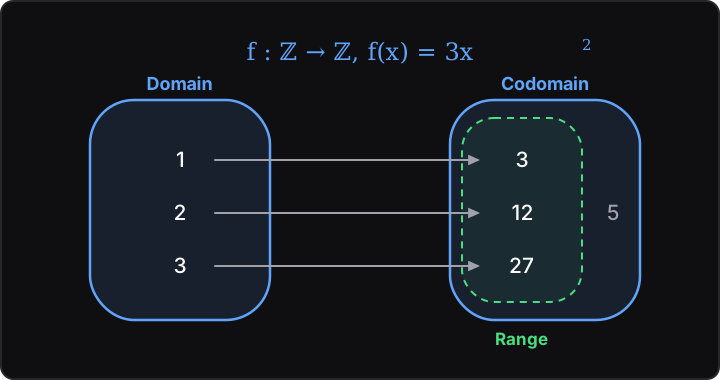
Then we have function types — injective, surjective, and bijective — which describe how the domain covers the codomain.
Next is evaluation: substituting a value into the function.
If \(f(x) = 3x^2\), what is \(f(5)\)?
Then compound (nested) functions — a function placed inside another function. Note that the order matters:
And finally, inverse functions: undoing a function by isolating its input.
Exam Correlations
Functions appears 23 times over 12 years, and the top partners are differentiation (14 shared appearances), Algebra (12), and integration (7).
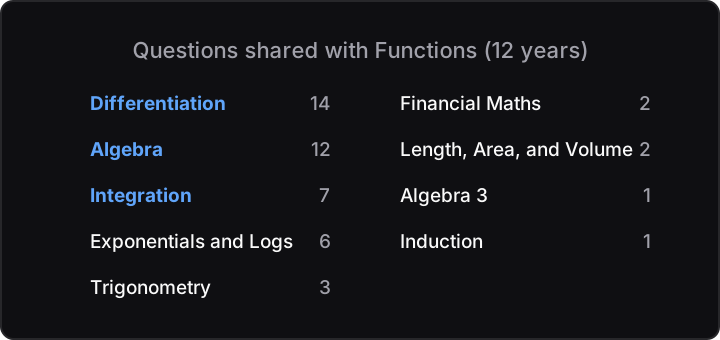
The differentiation pairing is the standout — calculus questions are posed entirely in function notation, and the chain rule is composition of functions in action. The algebra pairing works the usual way: manipulating a function means manipulating an algebraic expression.
Misreading a function when answering a question on another topic can derail your whole answer — the notation skills you build here are protective marks, not just functions marks.
Concept Connections
Functions is similar to number systems: it has no single strong dependency, but it is quietly everywhere, because the rest of the course is written in its notation.
Reading the notation carefully can change an answer. If a quadratic question gives you \(f : \mathbb{R} \to \mathbb{C}\), the range allows complex outputs — so a negative discriminant is not a dead end, it is a hint that the roots are complex.
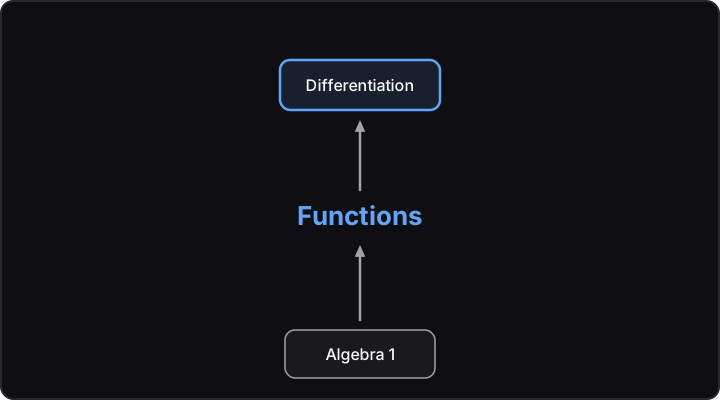
The clearest connection inward is from Algebra 1: finding an inverse function is the variable-isolation skill applied to the function's input.
And the clearest connection outward is to differentiation, through compound functions.
Study Order
There are five sub-topics in Functions. Unlike the algebra topics, there is not a strict chain here — the early steps are fairly independent — but this order lets the later steps lean on the earlier ones. Click each step to see how.
Properties
Start with the vocabulary: the domain is the set of inputs the function accepts, the codomain is the set its outputs are declared to come from, and the range is the set of outputs it actually produces — the range sits inside the codomain, but does not have to fill it.
These stand on their own, and everything else in the topic is described using them.
Function Types
Three labels that describe how a function uses its codomain. Injective (one-to-one): no two inputs share an output. Surjective (onto): every element of the codomain gets hit, so the range fills the whole codomain. Bijective: both at once — every output is used exactly once.
Fairly independent of the other steps, but they build directly on the domain/codomain/range picture from step one — and bijective functions are exactly the ones you can invert, which matters in the final step.
Evaluation
Substituting values into a function. Also fairly independent — this is order of operations applied inside function notation.
Compound Functions
Builds a little on evaluation: instead of substituting a number into the function, you substitute another function. Keep an eye on the order — \(f(g(x))\) and \(g(f(x))\) are different functions.
Inverse Functions
Mostly its own thing, built on the isolation skill from Algebra 1. But there is a neat link back to compound functions, and it is really the definition of an inverse: compose a function with its inverse and you get plain \(x\) back.
Know your gaps before the exam does
The MathsHelp course is everything you need for Leaving Cert Higher Level Maths, in one place. Smart testing pinpoints exactly where you are losing marks, explainer articles teach you the curriculum, an AI tutor works through your specific weaknesses, and real past papers — organised by topic, with guides — prove you are exam-ready.
- 7 articles on this topic
- 64 questions on this topic
- 1,300+ custom questions
- 280 explainer articles
- 12 years of past papers by topic