
Financial Maths
Compound interest, present value, and annuities: exponentials and the geometric series put to work on real money questions.
Topic Importance
Financial Maths is where the patterns chain pays out. It has appeared in 8 questions over the last 12 years — a smaller count than the headline topics, but the questions it does appear in are unusually formula-driven: recognise the situation, pick the right formula, and the marks follow.

It is also the most obviously real-world topic on Paper One: compound interest, loans, savings plans, and income tax are the exam dressing, but underneath they are the exponentials and geometric series you have already studied. If Sequences and Series is done, this topic is a short extra investment.
What the Topic Covers
The topic is built around one engine: compound interest. It starts with the future value of an investment — money growing exponentially — and then runs the same formula in every direction: solving for the time (which is where logarithms come in, because the time is the exponent), running growth in reverse as depreciation, and discounting a future amount back to a present value to judge whether an investment is worth making.
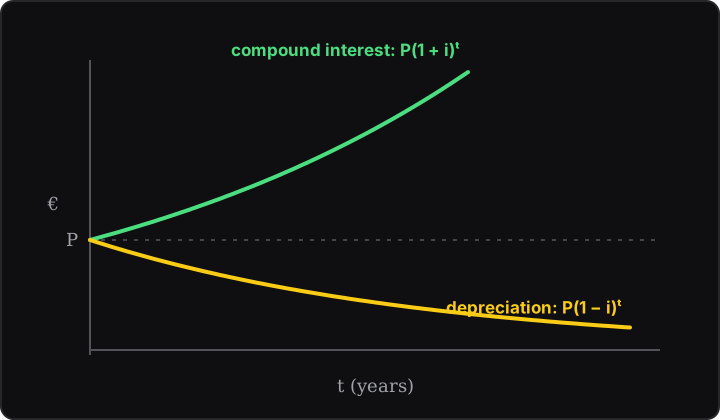
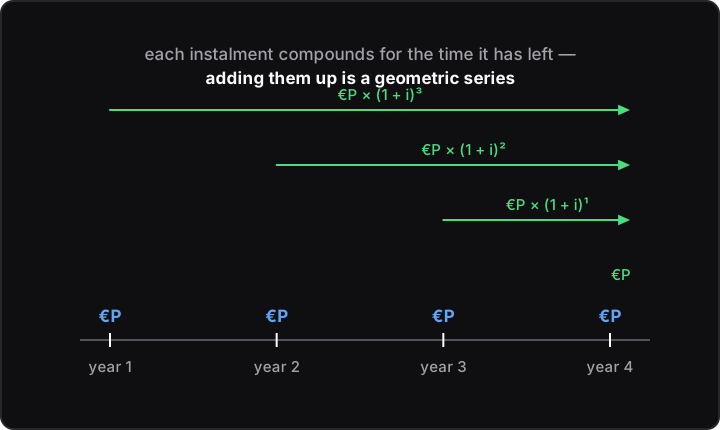
Around the engine sit the practical skills: converting interest rates between yearly and monthly, and savings plans and annuities — where regular instalments each compound for the time they have left, turning the total into a geometric series.
The topic closes with the money maths of work and business: business finance (gross and net profit, margin) and income tax calculations, both built on the percentage skills of Algebra 1.
€5,000 is invested at 4% per annum compound interest. Find the value of the investment after 10 years.
How many full years does it take an investment of €1,000 to exceed €2,000 at 6% per annum compound interest?
Exam Correlations
Financial Maths appears 8 times over 12 years, and its correlation counts are small and flat — six topics tied on 2 shared questions each.
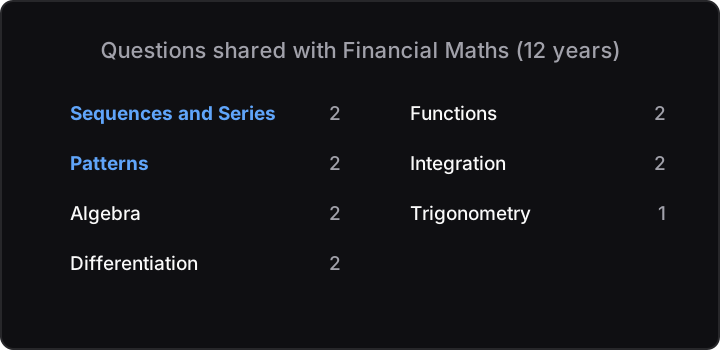
A note on the counts: "Algebra" bundles Algebra 1 and Algebra 2 together, and "Differentiation" bundles Differentiation 1, 2, and 3. With numbers this small, the standing caveat matters more than usual: co-occurrence in a couple of mixed questions tells you very little. The correlations that reflect a genuine mathematical link are Sequences and Series and Patterns — annuity and savings-plan questions are geometric series wearing a euro sign — and the table understates that dependence because financial questions are usually counted as their own topic.
Financial maths questions reuse the same handful of formulas year after year. If you have studied Sequences and Series, the remaining work is small — and the marks are among the most predictable on the paper.
Concept Connections
Financial Maths is the end of the line: the patterns chain runs Patterns → Sequences and Series → here, and nothing comes after it.
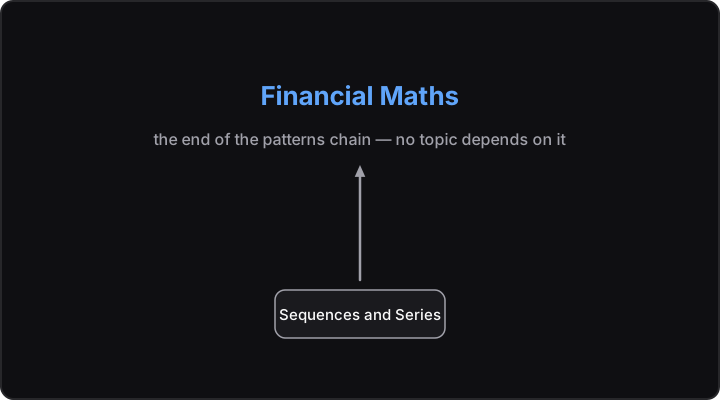
And outward? Nothing. No topic builds on Financial Maths — once it is done, the whole chain from Patterns is complete.
Study Order
There are eight sub-topics in Financial Maths: five that run the compound interest engine in different directions, then three that put it to work. Click each step to see how they build.
Compound Interest and Future Value
The engine of the whole topic: money invested at a compound rate grows exponentially, and the future value formula tells you what an investment made today will be worth. This is the exponential growth you met in Exponentials and Logarithms, wearing financial clothes.
Compound Interest: Finding the Time
The same formula, solved for a different unknown: given a target value, how long does the investment take? The time sits in the exponent — and identifying an exponent is exactly what logarithms are for.
Depreciation
Compound interest in reverse: instead of compounding growth, a compounding decay in value. The formula is the future value formula with the sign of the rate flipped.
Present Value and Investment Analysis
Steps 1 and 3 combined: run compound interest forward to find what an investment will pay out, then discount that future money back to today. If what you must spend now is less than the present value of what you will get, the investment is worth making.
Converting Interest Rates
Rates are quoted yearly but often applied monthly, so you need to convert between the two — and because compounding is exponential, the conversion uses roots and powers, not division by 12.
Savings Plans and Annuities
The step that needs Sequences and Series: in a savings plan you invest every month, and each instalment compounds for the time it has left. The instalments form a geometric sequence, so the total saved is a geometric series — summed with the \(S_n\) formula.
Business Finance
Away from investments and into the accounts: gross profit, net profit, and margin. Mathematically this is the percentage and rearranging toolkit from Algebra 1 applied to business quantities.
Income Tax Calculations
The final step: income tax and tax calculations in general — percentages of income at different rates, with credits subtracted. Like business finance, it runs on the Algebra 1 percentage skills, applied carefully in sequence.
Know your gaps before the exam does
The MathsHelp course is everything you need for Leaving Cert Higher Level Maths, in one place. Smart testing pinpoints exactly where you are losing marks, explainer articles teach you the curriculum, an AI tutor works through your specific weaknesses, and real past papers — organised by topic, with guides — prove you are exam-ready.
- 9 articles on this topic
- 38 questions on this topic
- 1,300+ custom questions
- 280 explainer articles
- 12 years of past papers by topic