
Exponentials and Logarithms
Powers and their inverse: the rules that quietly drive sequences, financial maths, and calculus across Paper One.
Topic Importance
Exponentials and logarithms has appeared in 23 questions over the last 12 years of past papers. But as we saw in the Paper One overview, the headline number understates it — this is one of the most connected topics on the course.

Exponentials turn up across the whole paper, often without being labelled. Sequences and series are built on powers, calculus questions hand you exponential functions to differentiate or integrate, and financial maths writes interest as an exponential.
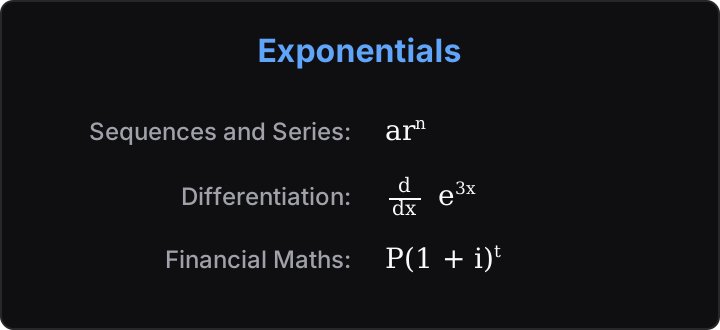
Master the rules here and they keep paying out across the rest of Paper One.
What the Topic Covers
The topic splits into two halves: the rules of exponentials, and then logarithms — the same ideas run in reverse.
Exponentials start with the definition — repeated multiplication written as a power — and build up the rules for combining them:
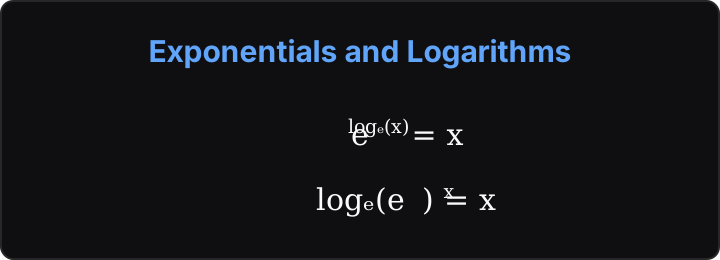
Logarithms begin with what a log even means. There are two ways to see the definition: \(\log_a b\) is the power of \(a\) you need to get \(b\) — so raising \(a\) to it gives \(b\) back. And applying \(\log_a\) to a power of \(a\) just reads off that power.
Evaluate \(\log_3 81\).
Exam Correlations
Exponentials and logarithms appears 23 times over 12 years, and its most frequent companions tell a story. The top shared appearances are Algebra 1, Algebra 2, and differentiation — at 9 each.
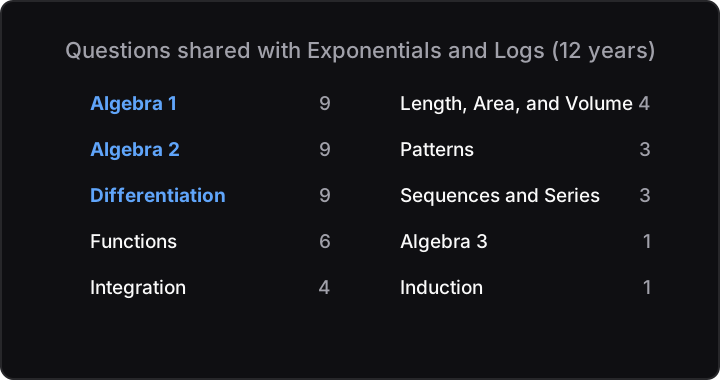
Calculus is a standout partner: when an exam question involves exponentials or logs, it very often asks you to differentiate them. And the algebra pairing works the same way it did in the algebra articles — an exponential equation usually needs algebraic manipulation to solve.
The usual caveat applies: appearing together does not always mean the mathematics is deeply linked. But the practical point stands — if you cannot handle the exponential and log rules fluently, marks in calculus and algebra questions are at risk, not just the marks labelled "logs".
Concept Connections
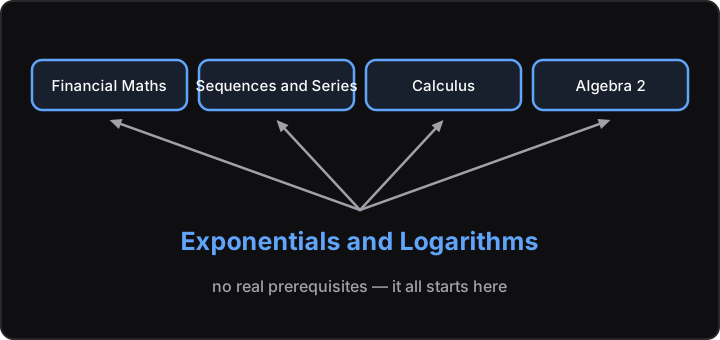
Exponentials and logarithms sits right at the start of the hierarchy — it has no real prerequisites. The connections all flow outwards, and they are some of the strongest on the course.
Study Order
The study order follows the same sequence as the topic itself: exponentials first, then logs, with each rule building on the ones before it. Click each step to see how.
Exponential Definition
Everything starts with what a power means: repeated multiplication, written compactly.
Multiplying Exponentials
Multiplying powers of the same base means adding the powers — expand each one and count: \(x^3 \times x^2\) is three \(x\)s times two \(x\)s, which is five \(x\)s altogether.
Dividing Exponentials
The obvious next step, because it is just the reverse: dividing powers of the same base subtracts the powers.
Powers of Powers
Expand the outer power using the definition: \((x^3)^2\) means \(x^3 \times x^3\), and by the multiplication rule that is six \(x\)s.
Negative Powers
This step combines multiplying and dividing. Multiplying by a negative power subtracts from the power — which is exactly what division does. And dividing is multiplying by a fraction, which is why a negative power is a fraction.
Log Definition
Start the second half with what a log means: \(\log_a b\) is the power of \(a\) that gives \(b\). Both identities below say exactly that, from each direction.
Adding Logs
The mirror image of multiplying exponentials: there, multiplying the values added the powers — here, adding the logs multiplies the values.
Subtracting Logs
The same connection, this time to dividing exponentials: subtracting logs divides the values.
Extracting Powers
The counterpart of powers of powers: a power inside a log comes out the front as a multiplier.
Change of Base
This one is a bit of its own thing, and the most complicated of the rules — which is why it comes last, once everything else is comfortable.
Know your gaps before the exam does
The MathsHelp course is everything you need for Leaving Cert Higher Level Maths, in one place. Smart testing pinpoints exactly where you are losing marks, explainer articles teach you the curriculum, an AI tutor works through your specific weaknesses, and real past papers — organised by topic, with guides — prove you are exam-ready.
- 7 articles on this topic
- 53 questions on this topic
- 1,300+ custom questions
- 280 explainer articles
- 12 years of past papers by topic