
Differentiation 3
The advanced block: velocity and acceleration, rates of change of shapes, and implicit differentiation.
Topic Importance
Differentiation as a whole is the most important topic on Paper One — 50 questions over the last 12 years, more than any other topic. Differentiation 3 is the final, advanced block: the applications, and the technique questions where the hardest differentiation marks live.
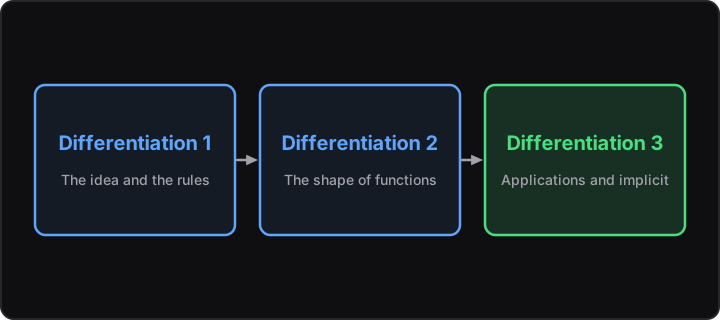
If the first two blocks are secure, this one is a short climb with a strong payoff — it is where full marks on a differentiation question are usually decided.
What the Topic Covers
Differentiation 3 covers the applications of differentiation, plus its most advanced technique.
The applications connect to physics: velocity is the derivative of displacement, and acceleration is the derivative of velocity — the second derivative of displacement. The same thinking applies to shapes, like finding the rate of change of a circle's area with respect to its radius.
Then comes implicit differentiation — differentiating equations where \(x\)s and \(y\)s are mixed together, rather than a tidy \(y = f(x)\).
Find \(\dfrac{dy}{dx}\) if \(x^2 + y^2 - 3x + y - 2 = 0\).
Exam Correlations
In our breakdown of the past papers, Differentiation 1, 2, and 3 are bundled together under the umbrella of Differentiation — whenever the correlation data says "Differentiation", it means that bundle. Taken together, it appears 50 times over 12 years, sharing questions most often with Algebra (20 shared appearances), integration (18), and functions (14).
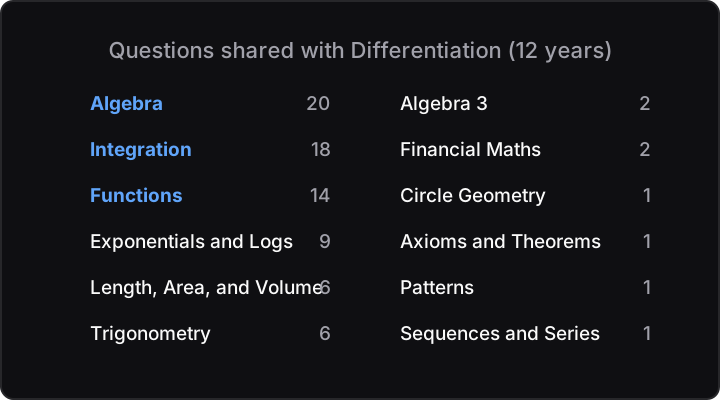
Two of the smaller entries belong to this block in particular: length, area, and volume (6 shared appearances) pairs with rates of change of shapes, and the physics-style applications are where differentiation meets the real-world contexts examiners like for part (c).
Concept Connections
Differentiation 3 draws on both earlier blocks and completes the chain into integration.
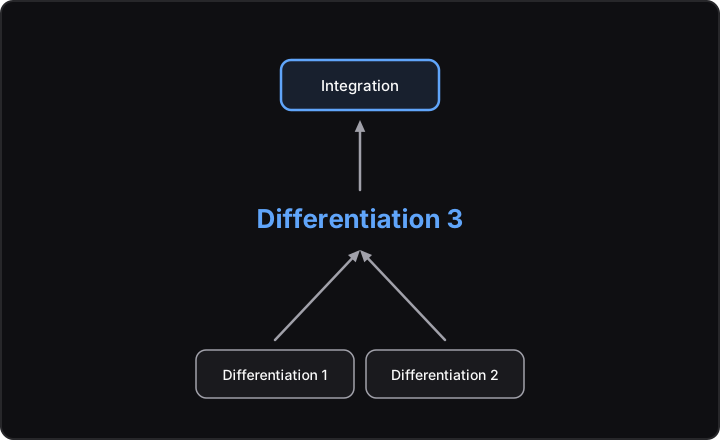
And onward, the flow leads to integration — the reverse operation. You will go back and forth between the two, and check the result of one using the other.
Study Order
There are two sub-topics in Differentiation 3, in this order. Click each to see how they build on the earlier blocks.
Rates of Change in Context
Differentiation applied to the real world. In physics terms: velocity is the derivative of displacement, and acceleration is the derivative of velocity — the second derivative of displacement, straight from block two. The same thinking applies to shapes, like the rate of change of a circle's area with respect to its radius.
Implicit Differentiation
The most advanced sub-topic, where \(x\)s and \(y\)s are mixed in one equation. Differentiate the \(x\) terms as normal; for the \(y\) terms, \(y\) is a function of \(x\), so the chain rule applies — \(y^2\) becomes \(2y \frac{dy}{dx}\). Then group the \(\frac{dy}{dx}\) terms and isolate them. It draws on several earlier sub-topics at once, which is why it comes last.
Know your gaps before the exam does
The MathsHelp course is everything you need for Leaving Cert Higher Level Maths, in one place. Smart testing pinpoints exactly where you are losing marks, explainer articles teach you the curriculum, an AI tutor works through your specific weaknesses, and real past papers — organised by topic, with guides — prove you are exam-ready.
- 4 articles on this topic
- 15 questions on this topic
- 1,300+ custom questions
- 280 explainer articles
- 12 years of past papers by topic