
Differentiation 2
The shape of functions: increasing and decreasing, second derivatives, turning points, and points of inflection.
Topic Importance
Differentiation as a whole is the most important topic on Paper One — 50 questions over the last 12 years, more than any other topic. Differentiation 2 is where those questions are usually going: the classic exam asks — where is a function increasing, where are its turning points, what kind of turning points are they — all live in this block.
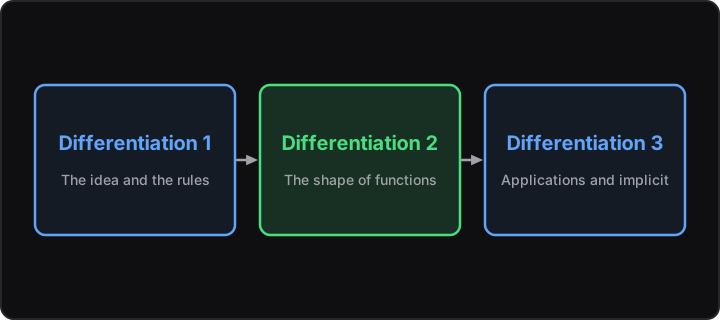
Differentiation 1 taught you how to compute a derivative. This block teaches you what to do with it.
What the Topic Covers
Differentiation 2 focuses on the rates of change of functions — using the derivative to describe a function's shape.
First, increasing and decreasing: the derivative is a function representing the rate of change, so where it is positive or negative tells you where the original function rises or falls. Then second derivatives — what they mean and how to compute them. Then turning points, the special case where the derivative equals zero, with the second derivative classifying each as a maximum or minimum. And finally points of inflection, where the slope itself switches from increasing to decreasing.
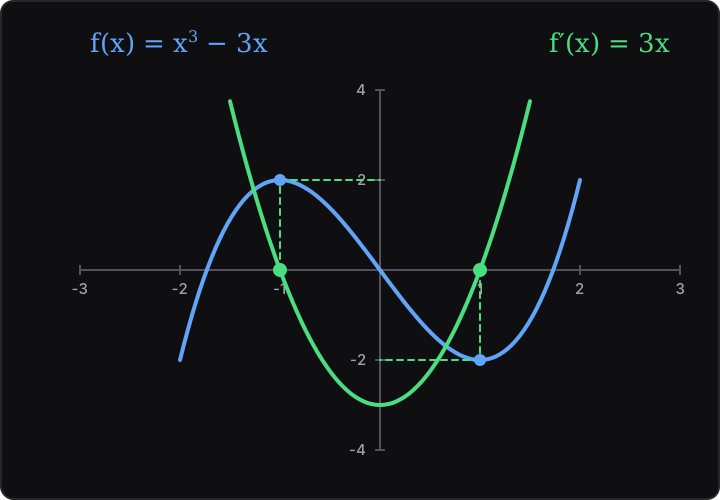
Find the turning points of \(f(x) = x^3 - 3x\) and use the second derivative to classify them.
Exam Correlations
In our breakdown of the past papers, Differentiation 1, 2, and 3 are bundled together under the umbrella of Differentiation — whenever the correlation data says "Differentiation", it means that bundle. Taken together, it appears 50 times over 12 years, sharing questions most often with Algebra (20 shared appearances), integration (18), and functions (14).
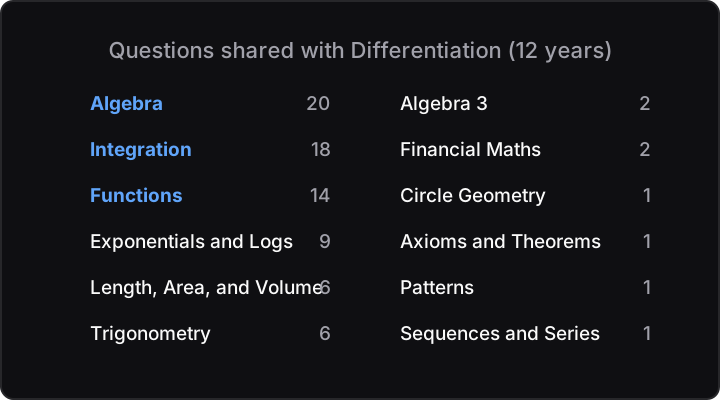
The algebra share matters especially for this block: finding a turning point of a cubic means differentiating it and then solving a quadratic — the Algebra 2 roots skill. Hidden inside the classic Differentiation 2 question is an algebra question.
Turning-point questions are among the most predictable on the paper. If your derivative rules and quadratic roots are both solid, this block converts them into reliable marks.
Concept Connections
This block sits in the middle of the differentiation chain.
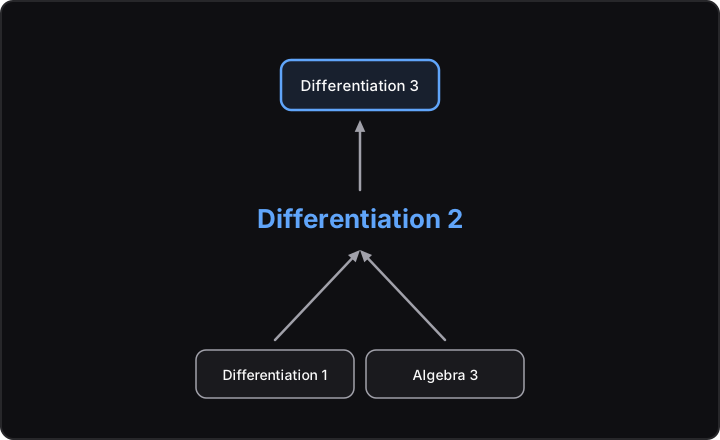
Onward, Differentiation 3 applies everything here to real contexts — velocity and acceleration are exactly the first and second derivatives you have just learned to read.
Study Order
There are four sub-topics in Differentiation 2, and they stack in strict order. Click each step to see how.
Increasing and Decreasing
The first derivative is a function representing the rate of change — where it is positive the function increases, where it is negative the function decreases. As noted in Algebra 3, finding those regions is a quadratic inequality on the derivative.
Second Derivatives
Differentiate the derivative and you get the rate of change of the rate of change. Learn what it means and how to compute it — the next two steps both use it.
Turning Points
The special case where the derivative equals zero rather than being greater or less than it. The second derivative — from the previous step — tells you whether each one is a maximum or a minimum.
Points of Inflection
Where the slope itself switches from increasing to decreasing (or vice versa) — which is not the same as the function switching direction; a function can keep increasing while its rate of increase falls. It happens where the second derivative is zero, and it comes last because it builds on everything in this block.
Know your gaps before the exam does
The MathsHelp course is everything you need for Leaving Cert Higher Level Maths, in one place. Smart testing pinpoints exactly where you are losing marks, explainer articles teach you the curriculum, an AI tutor works through your specific weaknesses, and real past papers — organised by topic, with guides — prove you are exam-ready.
- 5 articles on this topic
- 14 questions on this topic
- 1,300+ custom questions
- 280 explainer articles
- 12 years of past papers by topic