
Differentiation 1
The gateway to the biggest topic on Paper One: what differentiation means, and every rule from first principles to the chain rule.
Topic Importance
Differentiation is the most important topic on Paper One. It comes up every year, it is often the biggest topic on the whole paper, and taken as a whole it has appeared in 50 questions over the last 12 years — the highest count of any topic.

The course splits it into three blocks, and Differentiation 1 is the gateway: it teaches what differentiation means and every rule you will use. Nothing in the later blocks — or in the many exam questions built on differentiation — works without the rules you learn here.
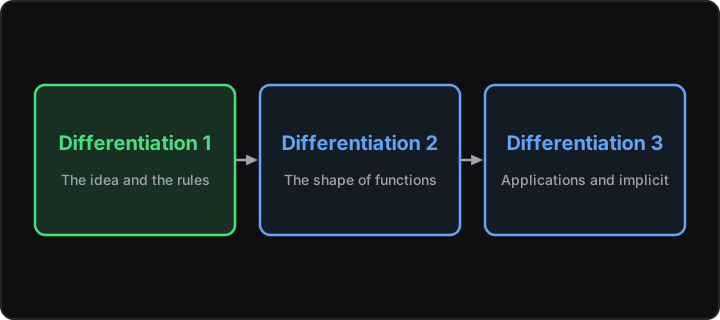
What the Topic Covers
Differentiation 1 teaches the basic concept — what differentiation means, why it works, and how to do it.
Differentiation is the instantaneous rate of change, captured by the first-principles equation. From there, the block builds up the rules one at a time: differentiating powers of \(x\), extracting constant coefficients, sums and differences, and combining those three into polynomial differentiation. Then the expression types broaden — exponentials and logs, then trig functions — before the block finishes on the hardest rules: the product and quotient rules, and finally the chain rule.
Differentiate \(f(x) = x^2\) from first principles.
Exam Correlations
In our breakdown of the past papers, Differentiation 1, 2, and 3 are bundled together under the umbrella of Differentiation — whenever the correlation data says "Differentiation", it means that bundle. Taken together, it appears 50 times over 12 years and shares questions with more topics than anything else on the paper: Algebra (20 shared appearances), integration (18), and functions (14) lead the list.
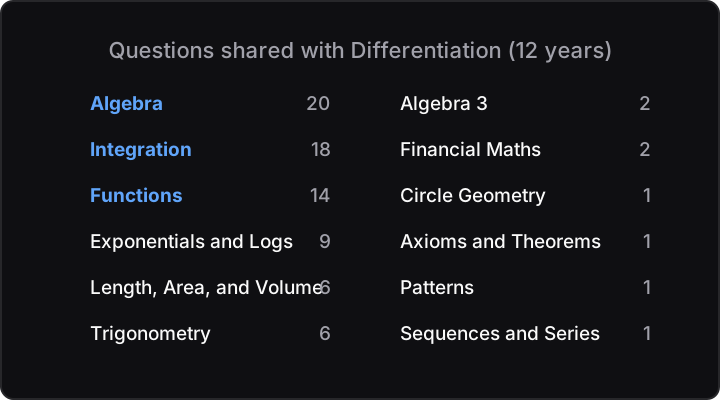
The pattern behind the numbers: exam questions hand you an expression from another topic — a polynomial, an exponential, a trig function — and ask you to differentiate it and do something with the result. Differentiation 1 is where you learn to do exactly that.
If you want the differentiation marks — and there are more of them than anything else — you also need the topics that feed it. That is the single biggest argument for following the study order in this series.
Concept Connections
Most of the connections flow into this block: earlier topics supply the expressions, and Differentiation 1 teaches you to operate on them.
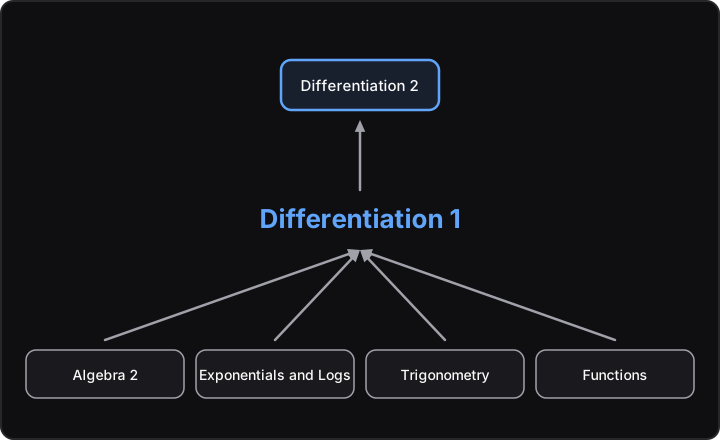
The outward connection is simple: everything else. Differentiation 2 and 3 apply these rules, and integration reverses them.
Study Order
There are nine sub-topics in Differentiation 1, and each builds on the ones before it. Click each step to see how.
First Principles
Start with what differentiation is: the instantaneous rate of change. The first-principles equation captures the idea, and everything else in the topic is a shortcut for it.
Powers of x
Your first rule for actually differentiating an expression — powers where the variable is in the base, like \(x^2\) or \(x^4\).
Constant Coefficients
A constant multiplier passes straight through the derivative — the first combining rule you learn.
Sums and Differences
The derivative of a sum is the sum of the derivatives — and the same for subtraction. Term-by-term differentiation becomes possible.
Polynomial Differentiation
Combine the last three steps and you can differentiate any polynomial: powers of \(x\) handle each term, the coefficient rule handles the multipliers, and the sum rule lets you work term by term.
Exponentials and Logarithms
A change of expression type rather than a new combining rule — no real connection to the steps before. You learn the derivatives of exponential and log functions.
Trigonometric Functions
The same again for sine and cosine — largely independent, though the coefficient rule reappears when you differentiate something like \(5\sin x\).
Product and Quotient Rules
The rules for differentiating a product of two functions, and a quotient of two functions. There is no trick to when they arrive — they are rules to master until you can recognise when and how to apply them.
Chain Rule
The rule for differentiating a function inside another function — the most difficult of them all, which is why it comes last. It leans on the compound-function reading skills from the Functions topic.
Know your gaps before the exam does
The MathsHelp course is everything you need for Leaving Cert Higher Level Maths, in one place. Smart testing pinpoints exactly where you are losing marks, explainer articles teach you the curriculum, an AI tutor works through your specific weaknesses, and real past papers — organised by topic, with guides — prove you are exam-ready.
- 12 articles on this topic
- 32 questions on this topic
- 1,300+ custom questions
- 280 explainer articles
- 12 years of past papers by topic