
Complex Numbers
The most self-contained topic on Paper One: from the imaginary unit and the Argand plane to polar form and De Moivre's theorem.
Topic Importance
Complex numbers has appeared in 14 questions over the last 12 years — and as we saw in the Paper One overview, it is the most dependable topic on the paper. It is always there, always worth about the same number of marks, and you will usually get one complex number question.

The nice thing about this topic is that it mostly stays on its own. If you want to score well in complex numbers, you can mostly get away with just knowing complex numbers — a predictable, self-contained source of marks.
What the Topic Covers
The topic starts with the concept: what a complex number even is. The key piece is the imaginary unit — \(i = \sqrt{-1}\) — and the two-dimensional picture: a complex number \(a + bi\) is a point on the plane, with the real part along one axis and the imaginary part along the other.
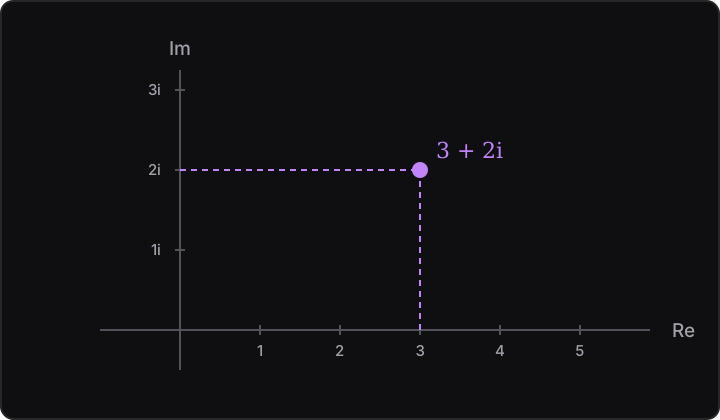
From there you learn the arithmetic in rectangular form: addition and subtraction, multiplication, and — via the conjugate — division. Then the topic moves to polar form: writing a complex number by its distance from the origin and its angle, converting back and forth from rectangular form, multiplying and dividing in polar form, and finally De Moivre's theorem for raising complex numbers to powers.

Write \(\dfrac{3+4i}{1-2i}\) in the form \(a + bi\).
Exam Correlations
Complex numbers appears 14 times over 12 years — but its shared appearances tell the real story. There are only four, each a single question: Algebra 1, induction, patterns, and sequences and series.

That makes it the most standalone topic on the paper. Where other topics' marks leak into each other, complex numbers keeps to itself: the question is about complex numbers, start to finish.
Fourteen appearances, four shared — this is as close as Paper One gets to guaranteed, self-contained marks. Learn the topic and the question is yours.
Concept Connections
There are no heavyweight inputs to complex numbers — just three light ones.
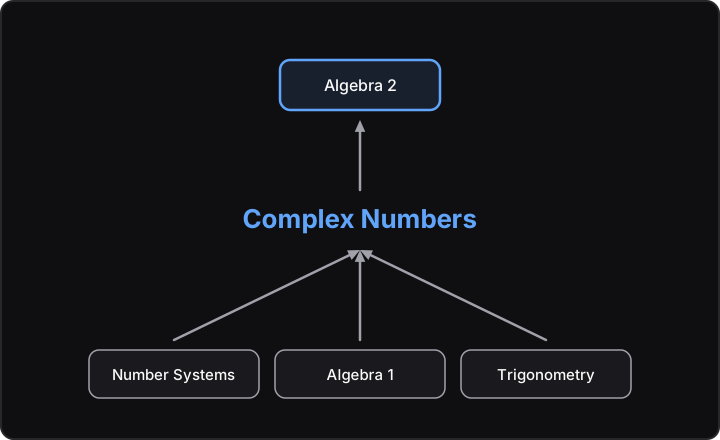
And outward, complex numbers leads to Algebra 2 in a small way:
Study Order
There are seven sub-topics in Complex Numbers, and the order runs from the concept through rectangular arithmetic to polar form. Click each step to see how they build.
The Concept of Complex Numbers
Partly covered back in Number Systems, but worth going over properly here — including the piece that was missing there: the imaginary unit itself. Then see a complex number plotted, as a point in two dimensions, introduced in rectangular form.
Addition and Subtraction
The gentlest arithmetic: combine the real parts, combine the imaginary parts.
Multiplication
Expand the brackets exactly as in Algebra 1, then use \(i^2 = -1\) to tidy the result.
The Conjugate and Division
These two are deeply connected — you need the conjugate to perform the division. Flipping the sign of the imaginary part gives the conjugate, and multiplying above and below by it turns the denominator real.
Polar Form
A new way to write the same number: by its distance from the origin and its angle. Learn to convert back and forth between rectangular and polar form.
Polar Multiplication and Division
Where polar form earns its keep: to multiply, multiply the moduli and add the angles; to divide, divide the moduli and subtract the angles.
De Moivre's Theorem
The final step: raising polar-form complex numbers to a power. It builds directly on polar multiplication — a power is repeated multiplication, so the angle is added \(n\) times.
Know your gaps before the exam does
The MathsHelp course is everything you need for Leaving Cert Higher Level Maths, in one place. Smart testing pinpoints exactly where you are losing marks, explainer articles teach you the curriculum, an AI tutor works through your specific weaknesses, and real past papers — organised by topic, with guides — prove you are exam-ready.
- 9 articles on this topic
- 44 questions on this topic
- 1,300+ custom questions
- 280 explainer articles
- 12 years of past papers by topic