
Algebra 3
Inequalities: from reading the symbols to solving quadratic inequalities and the disguised ones hiding inside fractions.
Topic Importance
Algebra 3 deals with inequalities. On the surface it is one of the smaller topics — it has appeared in 8 questions over the last 12 years of past papers.

But as we saw in the Paper One overview, inequalities are worth more than they look. They rarely stand alone: 6 of those 8 shared appearances are with Algebra, because the most common form is a polynomial inequality — a roots question with an inequality sign instead of an equals sign. If you can solve quadratics, a modest amount of extra work here turns that skill into a very reliable source of marks.
What the Topic Covers
Algebra 3 builds from reading the symbols up to solving disguised polynomial inequalities.
First, the meaning of the inequality symbols — greater than, less than, greater than or equal to, less than or equal to. This just establishes what we are even talking about.
Next, linear inequalities. Instead of just evaluating whether \(a > b\) is true, you are now finding which values of \(x\) make an expression true.
Then reversing inequalities: multiplying both sides by a negative number flips the sign.
Next, quadratic inequalities. These look a lot like roots equations — but instead of a quadratic equal to zero, it is greater than or less than zero. You still solve for the roots, then decide whether the answer is the range between them or outside them, based on the direction of the inequality and the shape of the quadratic.
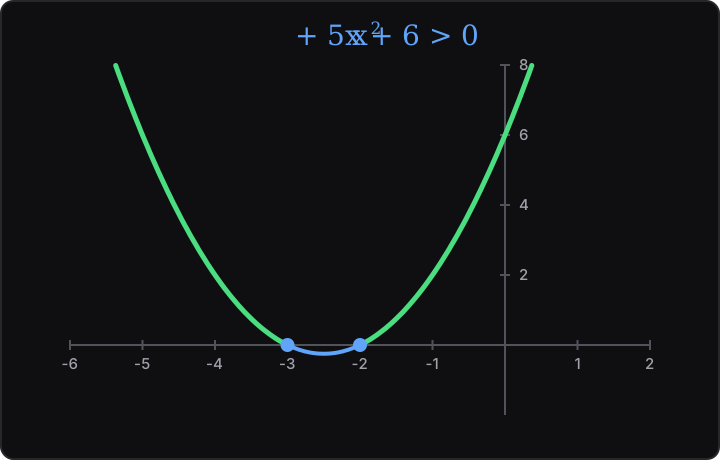
And finally, hidden quadratic inequalities — problems you must first transform into a quadratic inequality. We saw equations like this in Algebra 2, except with equality instead of inequality.
For what values of \(x\) is \(\dfrac{3x-1}{x-6} > 2\)?
Exam Correlations
Algebra 3 appears 8 times over 12 years, and the shared appearances are dominated by one partner: Algebra itself, with 6 of the 8.
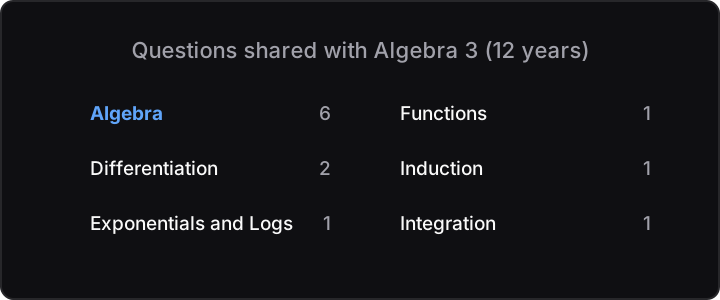
That is exactly what you would expect from the shape of the topic: exam inequalities are usually polynomial inequalities, so they sit inside or alongside algebra questions. The remaining appearances are scattered — a couple with differentiation, and single appearances across four other topics.
The marks story is simple: inequalities are an add-on to your quadratic skills. If Algebra 2 is solid, these are some of the most predictable marks on the paper.
Concept Connections
The connection picture for Algebra 3 is short and clear.
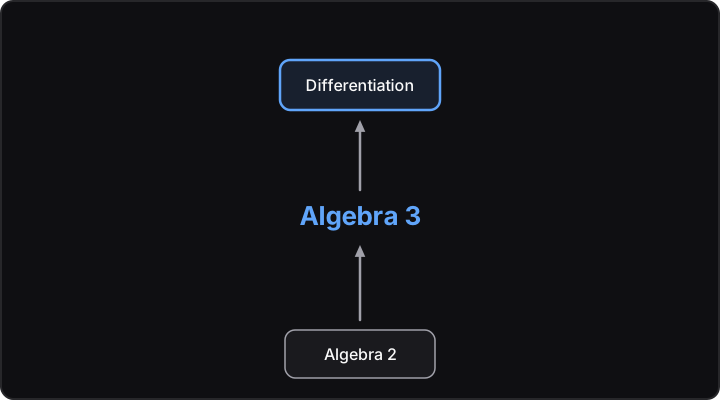
There is one main prerequisite: Algebra 2. The more challenging inequalities are polynomial inequalities, and solving them means finding roots — the core Algebra 2 skill.
After Algebra 3, there is some connection onward to differentiation. Asking when a function's slope is negative is the same as asking when its derivative is less than zero: differentiate a cubic and you get a quadratic representing its slope — where that quadratic is below zero, the cubic slopes downward.
It is not a huge connection — you can also determine the sign of the slope using the second derivative — but it is a nice example of inequality thinking showing up inside calculus.
Study Order
There are five sub-topics in Algebra 3, and each builds directly on the ones before it. Click each step to see how.
Meaning of the Symbols
Start by understanding what the four symbols say — no solving yet, just reading statements like \(a > b\) correctly. Everything else in the topic is a statement built from these.
Linear Inequalities
This step introduces the variable: instead of checking whether a statement is true, you find the values of \(x\) that make it true. The mechanics are the equation-solving you already know, with a range as the answer.
Reversing Inequalities
Multiplying both sides by \(-1\) flips the sign. This matters later: when you multiply across by the denominator of a fraction, the denominator might be negative depending on \(x\) — so you multiply by the square of the denominator, which is guaranteed positive, to avoid flipping the sign by accident.
Quadratic Inequalities
Builds on all of the above plus your Algebra 2 roots skills. Solve the quadratic as if it were a roots equation, then use the shape of the parabola and the direction of the sign to decide: between the roots, or outside them?
Hidden Quadratic Inequalities
The final step ties everything together, along with your Algebra 2 fraction skills. Clearing the fraction turns the problem into a quadratic inequality — and because the denominator could be negative, you multiply by its square, using the reversing rule you learned earlier.
Know your gaps before the exam does
The MathsHelp course is everything you need for Leaving Cert Higher Level Maths, in one place. Smart testing pinpoints exactly where you are losing marks, explainer articles teach you the curriculum, an AI tutor works through your specific weaknesses, and real past papers — organised by topic, with guides — prove you are exam-ready.
- 8 articles on this topic
- 51 questions on this topic
- 1,300+ custom questions
- 280 explainer articles
- 12 years of past papers by topic