
Algebra 2
The Algebra 1 toolkit put to work: simultaneous equations, surds, factorising, and finding the roots of quadratics and cubics.
Topic Importance
Algebra 2 is where the tools from Algebra 1 get put to work. In our analysis of the past papers, Algebra 2 is bundled with Algebra 1 under the umbrella of Algebra — and together, this grouped topic has appeared in 50 questions over the last 12 years. That is a significant presence on the exam.

But just like Algebra 1, the value goes beyond the algebra questions themselves. The topics that appear most often alongside Algebra in past papers are differentiation, functions, and integration. When you are working through a calculus problem or analysing a function, you will often need to factorise, solve simultaneous equations, or handle polynomials — all Algebra 2 skills.
Master this topic and you unlock marks in those areas too.
What the Topic Covers
Algebra 2 takes the foundational rules from Algebra 1 and applies them to polynomials and solving equations.
First, we have simultaneous equations. You start with two equations and two unknowns, learning to isolate one variable, substitute it into the other equation, and solve. The same technique then extends to three equations with three unknowns.
Next, we have surds and radicals. This is about simplifying square root expressions, recognising that a square root is really a power of a half, and knowing which numbers are surds and which are not — \(\sqrt{2}\) is a surd, but \(\sqrt{4}\) is just 2.
Then we move on to factorising quadratics. This includes the difference of squares, standard factorisation, and the quadratic formula for when factorising is not obvious.
Building on that, you will work with higher degree polynomials. The factor theorem connects roots to factors — so if you know one root of a cubic, you can divide out its factor and find the remaining roots.
And finally, we have quadratics in disguise. Some equations are really quadratics once you manipulate them.
Solve \(\sqrt{8x+20} = x\).
The key ideas running through all of this are the factor theorem, polynomial division, the quadratic formula, surds, and reasoning about coefficients and roots.
Exam Correlations
In our breakdown of the past papers, Algebra 2 is grouped with Algebra 1 under Algebra. This grouped topic most often appears alongside differentiation, functions, and integration in exam questions.
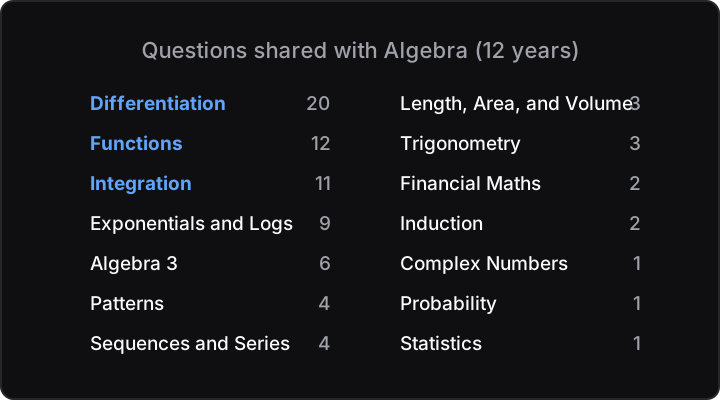
As with Algebra 1, some honesty about what this means: topics appearing together on the exam does not necessarily mean the mathematics is deeply connected. It often reflects how examiners construct questions — they set up a calculus problem that needs some algebraic manipulation, or test a function in a context where you need to factorise.
But here is the key point for your marks. Algebra appears 50 times over 12 years, and it frequently shows up alongside differentiation (20 shared appearances), functions (12 shared), and integration (11 shared). So Algebra 2 is not only worth the marks attached directly to algebra questions. If you struggle with quadratics, you will lose marks on differentiation and integration questions too.
Not because you do not understand the calculus — because you could not finish the algebra. Being strong here protects your marks across multiple topics.
Concept Connections
Now for the genuine conceptual links — the real mathematical dependencies.
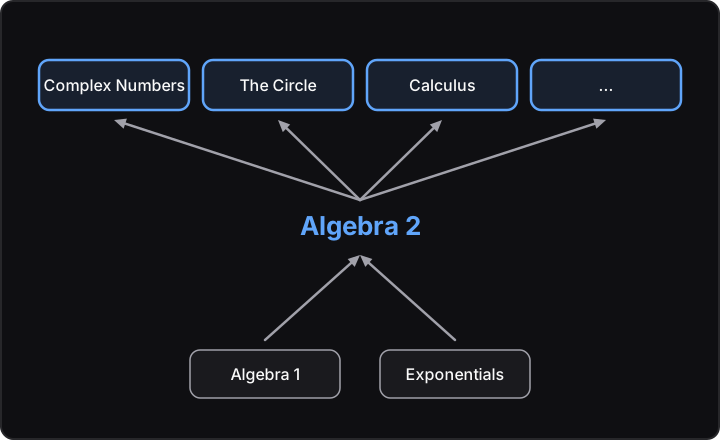
The dominant connection is backwards to Algebra 1. Algebra 2 uses those rules constantly: solving simultaneous equations is applied substitution, factorising a quadratic is running the expansion rules in reverse, and clearing denominators in a fraction equation is the fraction manipulation you learned there. Algebra 2 is really Algebra 1 applied to progressively harder polynomial problems. There is also a connection to exponentials through surds — a square root is just a power of a half, so radicals are really fractional exponents.
And then the connections flow outwards. The skills you build here — polynomial manipulation, solving systems of equations, the factor theorem — are prerequisites for complex numbers, coordinate geometry, and calculus.
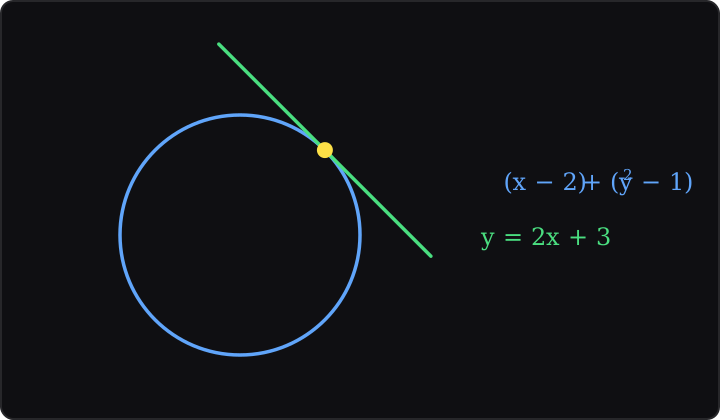 Simultaneous equations — you cannot find where a line meets a circle without solving a system of equations.
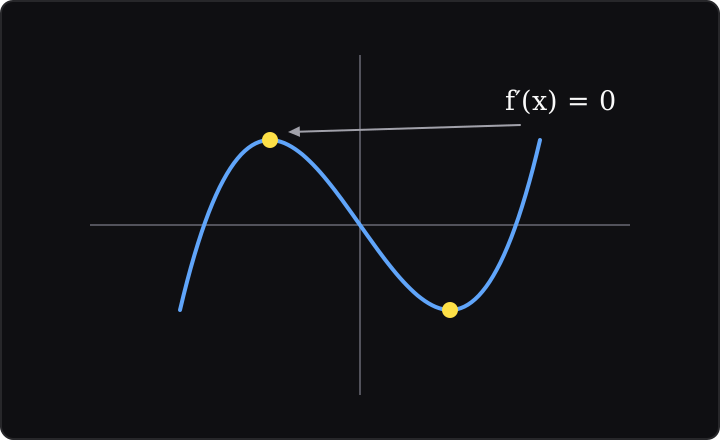 Solving polynomial equations — you cannot find the turning points of a function without solving a polynomial equation.
Algebra 2 provides the machinery those later topics depend on.
Study Order
There are six sub-topics in Algebra 2, which build on each other. Work through them in this order — click each one to see what it covers and how it builds on the steps before it.
Simultaneous Equations
Start by mastering two-variable systems using substitution: isolate one variable, plug it into the other equation, and solve. Then extend to three-variable systems, where you reduce step by step — three unknowns down to two, then two down to one.
This substitution technique comes back throughout the topic, so it is worth getting comfortable with it first.
Surds and Radicals
Learn to simplify roots — like breaking \(\sqrt{48}\) into \(4\sqrt{3}\) — understand that a square root is a power of a half, and recognise that squaring undoes a square root. You will need these skills for the equation solving later on.
Factorising Quadratics
Practise expanding brackets and recognising the reverse process — factorising. The big idea here is that roots and factors are two sides of the same coin: if \(r\) is a root, then \(x - r\) is a factor.
The Quadratic Formula
When factorising is not obvious, the formula gives you the roots directly. It is a universal method, and it is worth memorising.
Higher Degree Polynomials
Learn to multiply a factor by a quadratic to get a cubic, and to reverse that with polynomial division. The factor theorem then lets you break down cubics: find one root, divide out its factor, and solve the quadratic that remains.
Equations in Disguise
Fraction equations with variables in the denominator become quadratics when you clear the fractions. Root equations become quadratics when you square both sides. And mixed systems — one linear equation and one quadratic — use the same substitution you learned right at the start.
When you square both sides of an equation, always check for extraneous solutions — squaring can introduce answers that do not satisfy the original equation.
By the end, you will be able to solve systems of equations, handle polynomials up to cubics, find all the roots of quadratics and cubics, and spot when a complicated-looking equation is really just a quadratic in hiding.
Know your gaps before the exam does
The MathsHelp course is everything you need for Leaving Cert Higher Level Maths, in one place. Smart testing pinpoints exactly where you are losing marks, explainer articles teach you the curriculum, an AI tutor works through your specific weaknesses, and real past papers — organised by topic, with guides — prove you are exam-ready.
- 13 articles on this topic
- 46 questions on this topic
- 1,300+ custom questions
- 280 explainer articles
- 12 years of past papers by topic