
Algebra 1
The rules of manipulating expressions and equations — the toolkit you will reach for in every other topic on Paper One.
Topic Importance
Algebra 1 is where your mathematical toolkit truly begins. In our analysis of the past papers, Algebra 1 is bundled with Algebra 2 under the umbrella of Algebra — and together, this grouped topic has appeared in 50 questions over the last 12 years. That is a significant presence on the exam.

But here is what makes Algebra 1 even more valuable: it does not just earn you marks on Algebra questions. The topics that appear most often alongside Algebra in past papers are differentiation, functions, and integration. That means if you are weak in Algebra 1, you are not just losing marks on Algebra questions — you are potentially struggling with calculus and functions too.
Mastering these foundational rules now pays dividends across the entire Leaving Cert.
What the Topic Covers
Algebra 1 is about the rules of manipulating expressions and equations.
First, we have moving variables around an equation — which reorderings are valid, and which are not.

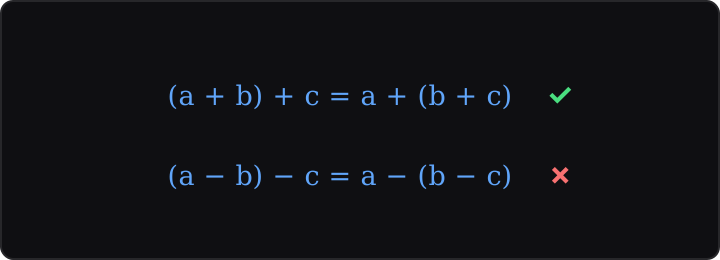
Then we have moving brackets across an expression. As we group different terms, does the value change?
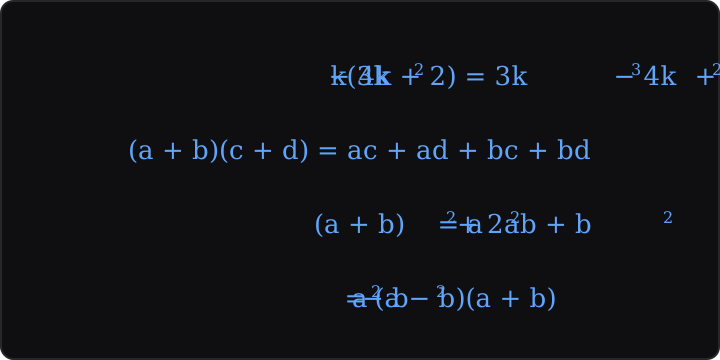
Next, we have expanding brackets — for example, scaling a polynomial by the variable, or multiplying factors. Building on top of that, you learn how to square factors, and from there, the difference of squares.
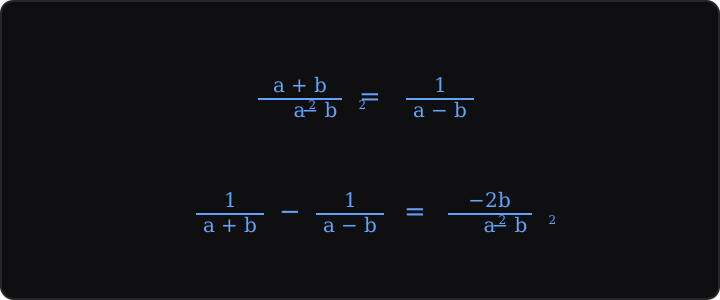
The next part of the topic is simplifying fractions. This means cancelling out common factors in the numerator and denominator — and it also means creating common factors to combine fractions.
Next, Algebra 1 introduces you to polynomials, which are essential to Algebra 2 and 3. You will just learn the basic structure of a polynomial here — what are the features that make up a polynomial?
And finally, you learn how to isolate variables. You will be given an equation, and you will need to rearrange it so that a targeted variable is on one side alone.
If \(\left(\frac{a-b}{c}\right)^2 = d\), what is \(a\)?
These are the tools you will use throughout the rest of the course, so learn them well.
Exam Correlations
In our breakdown of the past papers, Algebra 1 is grouped with Algebra 2 under Algebra. This grouped topic most often appears alongside differentiation, functions, and integration in exam questions.
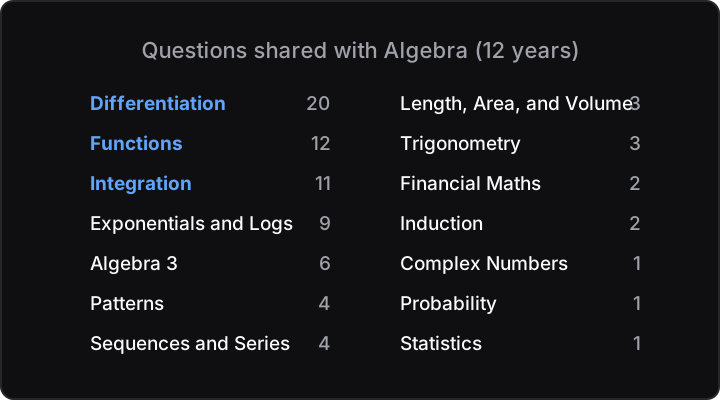
Now, to be honest about what this means: just because these topics appear together on the exam does not necessarily mean the mathematics is deeply connected. It could simply be that examiners like to bundle them into different parts of the same question. A question might have an algebraic setup in part (a), and then move into calculus in parts (b) and (c).
That said, this co-occurrence hammers home an important point about marks. If Algebra appears 50 times over 12 years, and it frequently shows up alongside differentiation (20 shared appearances), functions (12 shared), and integration (11 shared), then your algebra skills are not just unlocking algebra marks. Being strong in the foundational manipulation from Algebra 1 can help you access marks in those correlated topics too.
If your algebra is shaky, you might understand the calculus concept but still lose marks because you cannot simplify the expression correctly.
Concept Connections
Now let us talk about the genuine conceptual links — the real mathematical dependencies.
Algebra 1 sits near the base of the mathematical hierarchy. It establishes the rules for manipulating expressions, and almost everything else builds on top of it.
There are some connections inward. Algebra 1 draws on foundational notation introduced elsewhere. The main connection is to exponentials — specifically, understanding exponent notation. To expand (a + f)² correctly, or to recognise that q × q can be written as q², you first need to understand what it means to raise something to a power.
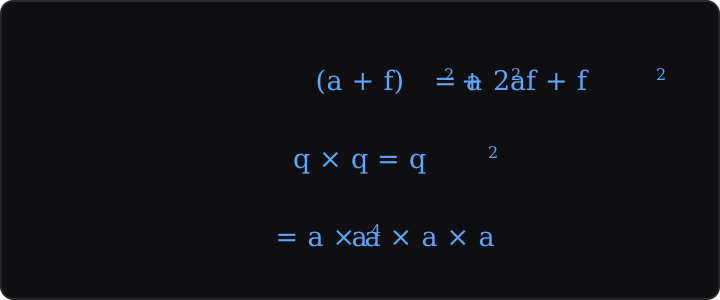
Expand \((x+y)^2\).
This concept is formally introduced in Exponentials and Logarithms, but you will apply it constantly when manipulating algebraic expressions.
But mostly, the connections flow outward — other topics build on Algebra 1. The rules you establish here — expanding, simplifying, factorising — become the tools you will use everywhere else. Here is exactly where each one shows up:
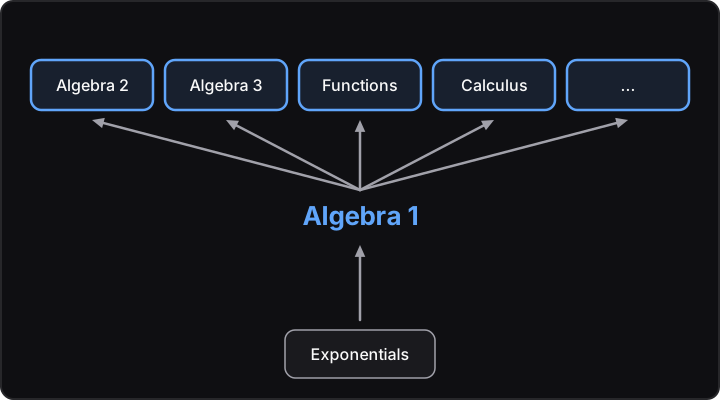
So while Algebra 1 has few incoming connections, it has many outgoing ones. Master it and you are laying the groundwork for everything that follows.
Study Order
There are nine sub-topics in Algebra 1, which build on each other. Work through them in this order — click each one to see what it covers and how it builds on the steps before it.
Commutative Property
The starting point. The commutative property means you can swap the values on each side of an operation. Addition and multiplication are commutative — for example, \(a + b = b + a\). But subtraction and division are not: \(a - b\) does not equal \(b - a\).
Associative Property
Another fundamental property of algebraic manipulation, alongside the commutative property. This one states that order does not matter when performing an operation repeatedly, meaning you can move brackets around to group different values: \((a + b) + c = a + (b + c)\). Addition and multiplication are associative; subtraction and division are not.
Sum Aggregation
Doing addition and subtraction with the same variable. Start with the basics, for example \(3x + 2x = 5x\). Pretty easy stuff, but you are laying the groundwork for the distributive property later.
Then move on to a more complicated form: summing fractions with common variables on the bottom. If you have \(\frac{2x}{y} + \frac{x}{y}\), think of \(\frac{x}{y}\) as a single variable \(a\) — so you have \(2a + a = 3a\), and translating back gives \(\frac{3x}{y}\). Again straightforward, but it lays the foundation for combining fractions later.
Product Aggregation
The same idea as sum aggregation, applied to multiplication: \(a \times a \times a = a^3\), and in the other direction, \((3x)^2 = 3x \times 3x\).
This is really an Exponentials and Logs concept, so we will not go into detail here. The point is that you need to be comfortable going back and forth between repeated multiplication and indices — you will need it for squared factors in the next step.
Distributive Property
Probably the first sub-topic here that can trip students up. It begins with multiplying a factor by a variable or number: you apply the multiplication to each item in the factor. One step more advanced is multiplying two factors — you go from a product of sums to a sum of products.
Once you are comfortable with that, move on to two special and common cases. The first is a factor squared: through product aggregation you know this is a factor multiplied by itself, and sum aggregation on the result gives the \(2ab\) term. The other is the difference of squares, which shows up in simplifying and combining fractions a fair bit.
Simplifying Fractions
A common factor on the top and bottom of a fraction can be cancelled out: \(\frac{x}{2x} = \frac{1}{2}\). The factor can be a simple variable like \(x\), or a factor you met in the distributive step, like \(\frac{a+b}{(a+b)^2} = \frac{1}{a+b}\).
Spotting the difference of squares is what unlocks the trickier cases: \(\frac{a+b}{a^2-b^2} = \frac{1}{a-b}\).
Combining Fractions
This takes what you learned from product aggregation and simplifying fractions and brings them together to solve a new problem: adding or subtracting fractions that do not share a denominator, like \(\frac{1}{x} + \frac{1}{y} = \frac{y+x}{xy}\).
You reverse-simplify the fractions so that they do have the same denominator, and then aggregate them. The example involving the difference of squares — \(\frac{1}{a+b} - \frac{1}{a-b} = \frac{-2b}{a^2-b^2}\) — is the most challenging version of this.
Polynomial Basics
Polynomials will dominate Algebra 2 and 3, so here you are just learning what a polynomial is, what it is made of, and how to evaluate it at certain values of \(x\). Finding roots or dividing quadratics will come in later algebra topics.
Isolation
Incredibly common, and used across practically all topics. Essentially, you need to learn how to undo each operation: \(+\, b\) is undone by \(-\, b\). So if \(a + b = c\) and you want to find \(a\), you subtract \(b\) from both sides, leaving \(a = c - b\).
When you need to undo multiple operations, recall the order of operations from Number Systems — and undo them in reverse order.
Know your gaps before the exam does
The MathsHelp course is everything you need for Leaving Cert Higher Level Maths, in one place. Smart testing pinpoints exactly where you are losing marks, explainer articles teach you the curriculum, an AI tutor works through your specific weaknesses, and real past papers — organised by topic, with guides — prove you are exam-ready.
- 12 articles on this topic
- 68 questions on this topic
- 1,300+ custom questions
- 280 explainer articles
- 12 years of past papers by topic